
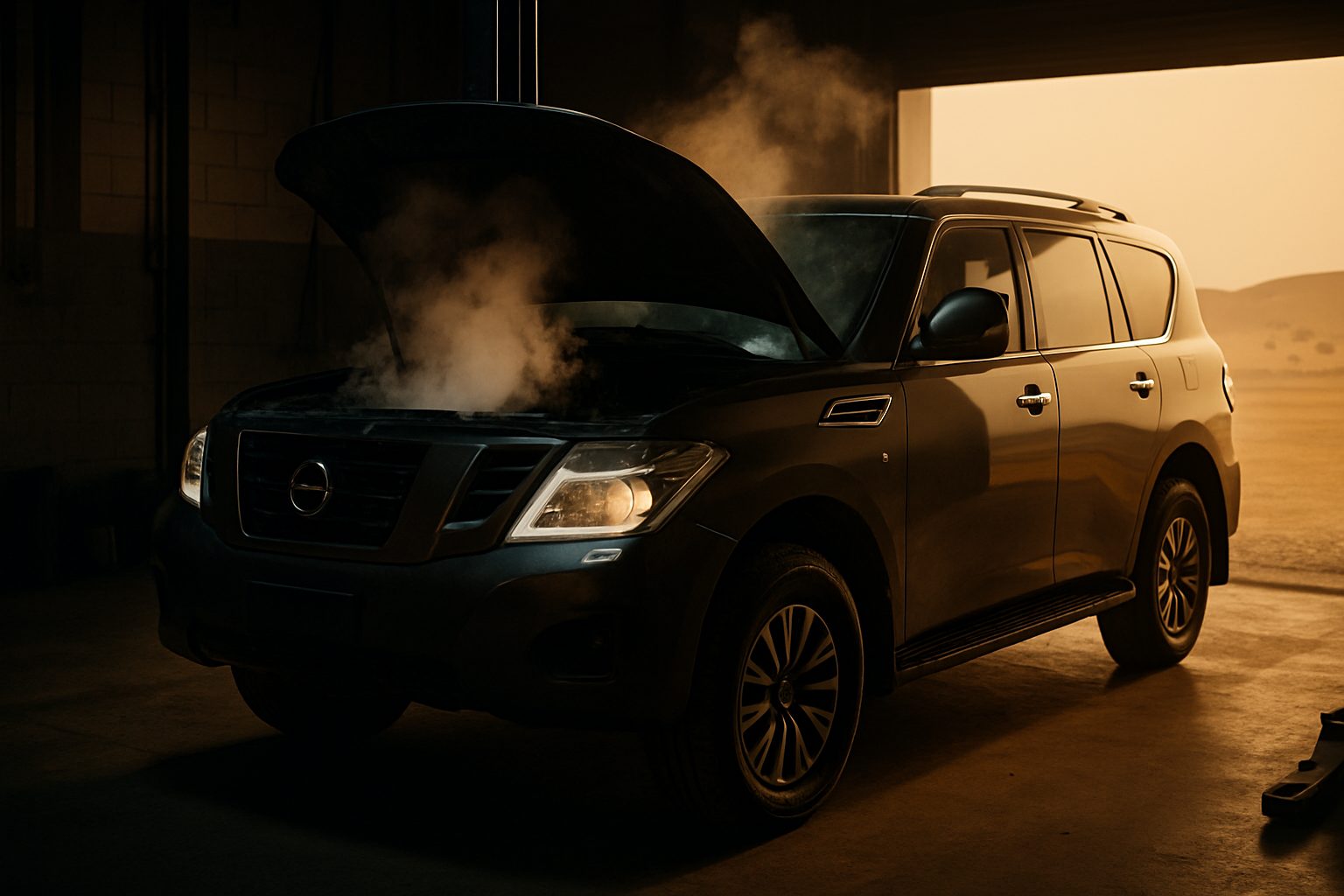
Part of: Nissan Patrol Y62 Cooling and AC Problems in Dubai
In UAE summer conditions, the Nissan Patrol Y62 overheats primarily because the VK56VD V8 generates a heat load that stop-start traffic, 45-50 degree C ambients, and sand-clogged airflow paths push beyond what the cooling system can clear. The most common causes are a degraded thermostat, a blocked or damaged radiator, a condenser fan running below the speed the system needs, and coolant that has lost its inhibitor capacity. Catching any of these early is the difference between a straightforward repair and an engine-off job.
The Y62 has been on UAE roads since 2010, and every summer the pattern repeats. A Patrol that ran fine through the winter starts running warmer than usual in June. The temperature gauge climbs a little higher than it used to, the AC loses ground in heavy traffic, or the car comes in smelling of something hot after a trip to Al Qudra. Owners often assume the car is just feeling the heat and leave it. That is usually when the straightforward fix becomes an expensive one.
The VK56VD V8 is a large-displacement engine in a heavy vehicle, and it produces a significant heat load under any conditions. In a UAE summer, that load does not drop at idle the way it would in a temperate climate. Sitting in a forty-minute queue on Sheikh Mohammed Bin Zayed Road with the AC set to maximum is as thermally demanding as sustained highway driving, and in some ways more so, because there is no ram air moving through the front grille to help the radiator and condenser do their work. The condenser fan has to carry the whole load. If anything in that chain is running below where it should be, the system runs out of headroom fast. What follows is what we actually look at when a Y62 comes in running hot, in the order we look at it.
What does Y62 overheating actually feel like from the driver's seat?
The first sign is usually a temperature gauge that sits slightly higher than normal after thirty or forty minutes in heavy traffic, often settling back down once the car reaches highway speed.
That recovery at speed is important. It tells you the cooling system can cope when there is airflow through the grille, but cannot cope on its own when the car is stationary. The condenser fan and the engine cooling fan are doing work the ram air would normally do, and something in that circuit is not keeping up.
A few other things owners describe: the AC blowing noticeably less cold in slow traffic, a faint hot smell from under the bonnet after parking, or occasionally a low coolant warning light. Some Y62s will also show a transmission temperature warning around the same time, because the gearbox is sharing the same hostile thermal environment. The engine and gearbox are separate cooling circuits, but they both suffer in the same conditions, so it is not unusual for symptoms to appear together.
What owners almost never notice, at least not at first, is coolant loss. A slowly failing thermostat or a partially blocked radiator does not usually announce itself with a visible leak. The car just runs warmer than it should, and then one day it runs much warmer.
The radiator and the thermostat: where we start
Before we touch anything, we check the coolant level and condition, and we look at the radiator from the front. Those two steps rule out the most common causes before any diagnostic tools come out. This is the work we do as our Y62 radiator and water pump work.
Sand and dust pulled in off Al Qudra or Liwa pack into the radiator fins over time. On a car with high mileage and a lot of off-road use, the restriction can be significant. Airflow through a packed radiator drops, coolant temperatures rise, and the system starts running at the edge of its capacity. A pressure wash of the front end clears minor cases. More advanced cases involve fins that have been bent or corroded, which means the restriction does not wash out.
The thermostat is the next thing we look at. The VK56VD runs a wax-element thermostat, and they fail in two directions. A thermostat that sticks closed causes rapid overheating at all speeds, which tends to bring the car in quickly. A thermostat that sticks partially open is harder to catch: the engine runs slightly cooler than it should at highway speed, the ECU compensates with a richer fuel mix, and in traffic the system cannot reach the temperatures it needs to manage properly. That second failure mode often shows up as higher than expected fuel consumption before it shows up as an overheating complaint.
We check coolant condition at the same time. Coolant that has not been changed in a long time loses its inhibitor capacity. When that happens, corrosion starts inside the cooling passages, and the radiator starts to foul from the inside rather than the outside. The coolant may look acceptable on a visual check and still be doing very little to protect the system.
The condenser fan is often the real problem in stop-start traffic
On a Y62 that overheats specifically in slow traffic but not on the highway, the condenser fan is the most common cause we find.
At highway speed, ram air does most of the work of pushing heat out of the condenser and radiator. When the car slows down, the electric condenser fan has to take over. If that fan is drawing low current, running at reduced speed, or cutting out intermittently, the condenser pressure climbs, the refrigerant stops absorbing cabin heat properly, and the engine coolant temperature rises at the same time because the two systems share the same airflow path at the front of the car.
We check the fan by running it through its full speed range and measuring the current draw. A fan that spins when tested but draws less current than it should is already on its way out. The motor windings are degrading, and in the middle of a Dubai summer it will eventually stop. We also check the fan relay and the temperature sensor that triggers it, because a fan that never gets the signal to run at full speed behaves identically to one that physically cannot.
Sand ingress plays a part here too. The fan draws air from the front of the car, and in a vehicle that does regular desert trips, dust works into the motor bearings. Bearing drag is one reason current draw goes up while fan speed goes down.
What a cooling system check actually involves on the ramp
Once the car is up, we work through the system in order rather than going straight to the most expensive component.
We start with a pressure test on the cooling system. This tells us whether the system holds pressure, and if it does not, where it is losing it. A failed pressure cap is a common and inexpensive finding. A leaking hose connection is the next most common. A head gasket starting to fail shows up here too, though on a well-maintained VK56VD that is not a frequent finding.
We check the water pump while the cooling system is under pressure. The impeller on these pumps can corrode and shed material over time, reducing flow without causing an obvious external leak. A pump that looks intact from the outside can be moving significantly less coolant than it should. We look at flow rate, not just whether the pump is turning.
The coolant itself gets tested for inhibitor depletion and for combustion gas contamination. Combustion gases in the coolant indicate a head gasket fault and change the entire direction of the job. That is a finding we want to know about before we spend time on anything else.
We also pull any stored fault codes from the engine management system. The VK56VD logs coolant temperature data, and a scan tool gives us a history of how the engine has been running, not just how it is running right now.
What happens if you leave it
A cooling system that is running at the edge of its capacity does not stay there. The progression is predictable.
Sustained high coolant temperatures accelerate the breakdown of the coolant's inhibitors, which accelerates internal corrosion, which narrows the cooling passages further. The system that was borderline becomes clearly inadequate. At some point the coolant temperature crosses into the range where the engine management system starts pulling timing and reducing power to protect the engine. Owners notice this as a loss of performance, sometimes without any warning light.
Further along, head gasket integrity comes under pressure. The VK56VD uses an aluminium block with aluminium heads, and aluminium is more sensitive to thermal cycling than iron. Repeated episodes of elevated temperature weaken the gasket seating. A head gasket job on a V8 is a significant amount of work regardless of what caused it.
The transmission adds its own variable. The JR710E gearbox has its own cooler, but it sits in the same environment as the engine, and in a car that is consistently running hot, the transmission fluid degrades faster. Gearbox damage in an already-overheating car is a separate repair on top of whatever the cooling system needed.
None of this is inevitable. The cooling system on the Y62 is a durable design. What causes these cascades is leaving a known symptom unaddressed through a UAE summer.
Service history and mileage change the picture
Two cars presenting with identical symptoms can need very different amounts of work depending on how they have been maintained.
On a car with a documented service history where coolant has been changed regularly and the system has been inspected, we often find one component at fault and the rest of the system in good condition. The job is contained. On a car at high mileage where service records are sparse or missing, we typically find multiple things running below where they should be. The radiator is partially blocked, the coolant is depleted, the fan is drawing low current, and the thermostat is sluggish. No single component is catastrophically failed, but the combination is enough to push the system over the edge in a UAE summer.
Mileage without context does not tell us much. We have seen high-mileage Y62s in excellent cooling system condition and lower-mileage ones in poor condition. What matters is how the car has been used and whether the fluid changes and system checks have kept pace with that use. That is what we ask about when a car comes in.
Common questions from Y62 owners
Can I keep driving my Y62 if the temperature gauge is a little high?
A gauge that is running above its normal position is the cooling system telling you it has lost margin. In a UAE summer, that margin disappears quickly. Continuing to drive risks accelerating the fault to the point where the engine management system starts pulling power, or further to head gasket damage. We would not recommend driving it further than necessary to get it to a workshop.
Why does my Y62 only overheat in traffic and not on the highway?
At highway speed, airflow through the front grille handles much of the cooling load. In slow traffic, that airflow drops to nearly zero and the condenser fan has to compensate. If the fan is running below full speed, or the radiator fins are packed with dust and restricting airflow, the system cannot cope at low speeds even though it manages at higher ones. A condenser fan check and a radiator inspection are the right starting points for this symptom.
Does the Y62 need a coolant flush or just a top-up?
A top-up replaces volume but not inhibitor capacity. Coolant that has been in the system for a long time has depleted inhibitors regardless of the level in the reservoir, and depleted inhibitors allow corrosion to build up inside the cooling passages. We recommend a full flush and refill rather than a top-up on any car where the last coolant change cannot be documented. A top-up on old coolant leaves the underlying problem in place.
Will the AC problem and the overheating fix themselves once the weather cools down?
The symptoms may ease in cooler months because the system has more thermal margin to work with. The underlying fault does not go away. A partially blocked radiator, a degraded fan motor, or depleted coolant will all be in the same condition the following summer, and the system will have spent months running slightly harder than it should. Fixing it outside of peak summer is the better approach, because the work is more straightforward when the car is not also cooking in a parking lot between sessions.
Is the Y62 more prone to overheating than other SUVs in the UAE?
The VK56VD is a large-displacement V8 in a heavy vehicle, so it produces more heat per hour than smaller engines. The cooling system is sized for that load, but the UAE's combination of extreme ambient temperatures, stop-start traffic, and dust ingress gives it less margin to work with than a temperate climate would. The Y62 is not a fragile car; it is a capable one being used in conditions that are genuinely demanding. Regular cooling system checks, appropriate coolant changes, and prompt attention to early symptoms keep it running without problems.
When to bring it to Top Challenger
We work on the Y62 and nothing else, at our workshops in Ras Al Khor and Mussafah. Send us a message on WhatsApp with what the car is doing and we will tell you what we need to look at and what the job is likely to involve. We handle Y62 servicing and repair at the Ras Al Khor workshop.
Last updated: September 2026