
Part of: Nissan Patrol Y62 Cooling and AC Problems in Dubai
A coolant leak on a Nissan Patrol Y62 in UAE conditions is almost always at the header tank seams, a hose union, the radiator end tanks, or the water pump weep hole. We pressure-test the cold system first, watch the gauge rather than hunt for a puddle, and follow the drop to its source before anything is removed. The repair that follows depends on what the test shows, not on what looks most likely from outside.
The VK56VD runs hot by design. It is a 5.6-litre V8 in a vehicle that weighs over 2,800 kg, and in Dubai and Abu Dhabi that engine spends a meaningful part of its life idling in traffic at 45 degrees with the air conditioning pulling hard. That combination puts the cooling system under sustained load that a temperate climate never produces. Rubber softens, plastic end tanks go brittle from repeated heat cycles, and the water pump impeller can erode quietly without ever throwing a warning light until the level has dropped enough to matter. What usually brings an owner in is a smell, a small puddle under the car in the morning, or a temperature needle that climbs in slow traffic but settles on the motorway. That last pattern is worth paying attention to, because it tells us something specific about where to look. A leak that only shows up under pressure, a fan that can barely move air once the car is stationary, and a thermostat stuck partly open all read differently, and they get treated differently. We start with a pressure test because it separates them.
What does a coolant leak on a Y62 actually look like?
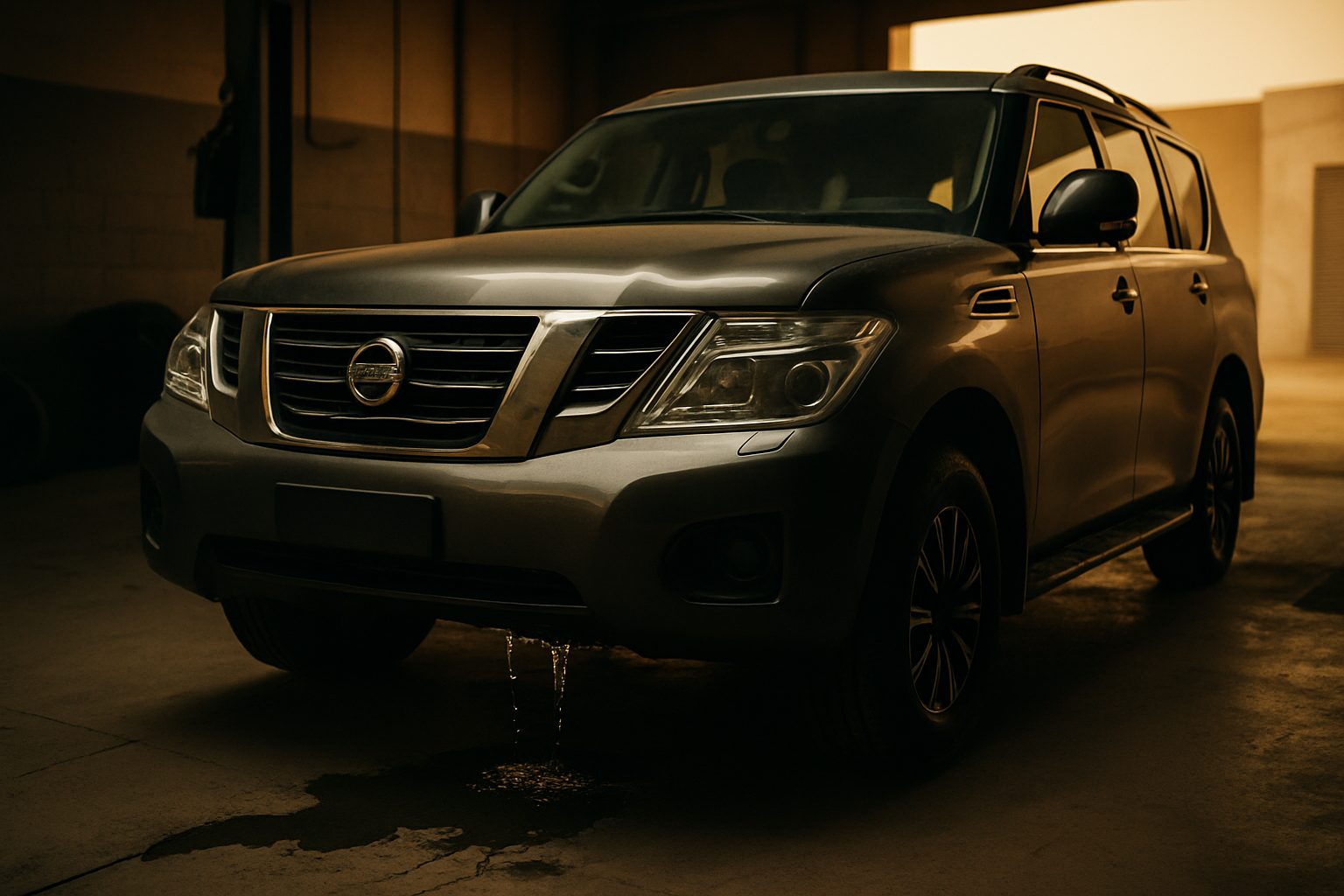
The most common presentation is a sweet smell from the engine bay and a puddle, usually below the front-left of the engine, after the car has been parked overnight.
Antifreeze has a distinctive smell and it does not evaporate cleanly, so even a slow weep leaves a trace. A puddle directly under the water pump points one way. A residue on the inside of a hose union, or a dried deposit on the outside of the radiator end tank, points somewhere else entirely. Owners sometimes describe the temperature gauge climbing in stop-start traffic on Sheikh Zayed Road, then settling once they reach speed, and that pattern matters: a car that cools down under load but overheats at idle is almost always a fan or an airflow problem rather than a hose or a gasket. The location and timing of the symptom narrows the cause before we have even looked under the bonnet.
Pressure test before anything else
We put the cold system on a hand pump and watch the gauge for a drop, because a slow leak shows on the gauge long before it marks the floor. This is the work we do as Y62 air conditioning repair.
A common mistake is to look for a visible puddle with the engine warm and the system under operating pressure. By then you are working around hot components and the leak source may not be where the fluid ends up. A cold pressure test is safer and more precise. We pressurise to the cap's rating, then watch. The gauge drops if there is a breach, and we follow it. The pressure cap itself gets tested at the same time: a cap that vents early lowers the boiling point of the entire system and produces an overheat with nothing mechanically broken.
On a Y62, the places that give up first are fairly consistent. The header tank seams crack from thermal cycling. Hose unions dry out and weep at the point where the hose clamp meets aged rubber. The radiator end tanks, which on this car are plastic bonded to an aluminium core, develop hairline failures at the seam. The water pump has a purpose-built weep hole that shows when the shaft seal has started to go. None of these are catastrophic on their own if caught early. Left alone, any of them can put the engine in a position where coolant loss goes unnoticed until real heat damage is done.
The water pump: what erosion looks like in practice
A water pump that sounds fine can still be circulating a fraction of what the system needs, because the impeller erodes rather than breaks.
On higher-mileage Y62s, this is one of the more quietly damaging failures we see. The impeller sits in the coolant constantly, and in a system that has not had the coolant changed on a reasonable schedule, the corrosion inhibitors deplete and the aluminium impeller starts to lose material. From outside the engine the pump sounds normal. Bearing noise is the tell most people know to listen for, but an eroded impeller can have perfect bearings. The only reliable way to confirm it is to pull the pump and inspect it. We check coolant flow by comparing the temperature at the top and bottom hose once the thermostat has opened: a core moving coolant properly shows a clear drop across it. A lazy drop, with a pump that sounds fine, puts the water pump in the frame.
Radiator and fan: the airflow side of the problem
A radiator core packed solid with fine sand passes the pressure test clean but cannot hand its heat to the air, so the engine runs hot with no visible leak and no fault code.
This is specific to this climate. Al Qudra, Big Red, Liwa, any desert driving at all pushes fine particulate through the front of the vehicle constantly. The radiator and the air conditioning condenser sit in the same stack, and once the gaps between the fins fill with dust and sand, airflow collapses. At motorway speed there is enough ram air to keep things in range. At idle in traffic, the fan is doing all the work, and if the fan is marginal too, the system fails to cope. We clean a blocked core and re-test. That is not billed as a repair; it is part of the diagnosis. If the temperatures come back into range after cleaning, the core was the cause and cleaning was the fix. If they do not, we keep looking.
The fan clutch on this engine degrades gradually, which makes it hard to notice from the driver's seat. By the time the clutch is slipping badly, the car may have been running borderline for a long time without a single warning light. We test it by checking whether the fan pulls hard when the engine is warm and the car is stationary. A slipping clutch that sounds plausible under load will show itself in that condition.
When the leak is at the head gasket
A head gasket failure on a Y62 presents differently from an external coolant leak, and the two are not the same job.
External leaks, everything described above, are mechanical failures of seals, seams and joints. A head gasket breach allows combustion gases into the coolant or coolant into the combustion chamber, or both. The visible signs overlap with other causes: a rising temperature gauge, occasional white smoke from the exhaust, a coolant level that drops without a visible external leak. The confirmation test is a combustion gas test on the coolant, which detects exhaust gases dissolved in the fluid. We run that test only when the pressure test comes back clean, coolant movement is confirmed, and the radiator is clear. Jumping to a head gasket conclusion without ruling out the simpler causes is how expensive and unnecessary work gets done.
If the combustion gas test is positive, the job is a full head-off inspection on the VK56VD. The heads come off, the block and head faces are measured, and we establish what caused the failure before reassembling anything. On a V8 this is a significant job, and doing it properly means understanding whether the gasket failed because of an underlying problem, overheating history, or a manufacturing issue in the sealing surface. The worn parts come out alongside the new ones so the owner can see what was there.
What gets damaged when a coolant leak is left alone
The sequence of damage from an unaddressed coolant leak is predictable, and each stage is more expensive to correct than the one before it.
A small external leak drops the coolant level gradually. If the level drops far enough, the water pump starts moving air rather than fluid, and coolant movement stops. Without movement, localised hot spots develop in the block and heads. The aluminium heads on the VK56VD distort under sustained overheat, and a distorted head face will not seal a new gasket without a proper resurface. If the distortion is severe enough, the head cannot be saved. A repair that was a hose union or a water pump becomes a head job, then potentially a rebuild. How quickly that progression happens depends on how depleted the coolant level was when the overheat occurred, and whether the engine was driven through a warning or shut down as soon as the gauge climbed.
Cars with a documented service history and coolant that has been changed on a reasonable schedule tend to have more margin before a small leak becomes a big one, because fresh coolant with active inhibitors is less corrosive to the system components around it. Cars that have run on the same coolant for a long time are at the other end of that scale.
Common questions from Y62 owners
Can I top up the coolant and keep driving while I wait for a repair?
Topping up buys a small amount of time, but it does not tell you how fast the system is losing fluid or where it is going. If the level drops again within a short drive, the leak rate is high enough that driving risks an overheat. The risk with continuing to drive is not the top-up itself but the fact that you lose visibility of how quickly the level is falling. A pressure test before you drive further is a much better answer than monitoring the gauge and hoping.
My temperature gauge only climbs in traffic, not on the motorway. Is that still a leak?
Not necessarily. That pattern, warm in traffic and fine at speed, points toward airflow or fan rather than a leak. At speed, ram air does the work. At idle, only the fan does, and a blocked radiator core or a failing fan clutch cannot cope with the heat load. We check the pressure and the fan before assuming there is a breach in the system.
How often should the coolant be changed on a Y62 in the UAE?
Nissan publishes a coolant change point in the owner's manual, but the UAE climate works the corrosion inhibitors harder than a temperate environment does. We recommend changing the coolant on a shorter schedule than you might follow in a cooler climate, and we base that on the condition of the fluid we drain rather than a fixed number. Old coolant that has lost its inhibitors accelerates corrosion of the aluminium components it is supposed to protect, and that damage shows up as a blocked radiator or an eroded impeller rather than anything you can see from the driver's seat.
Is there a coolant type I should be using on the Y62?
The owner's manual specifies the coolant type for this engine. What we recommend beyond that is to use the correct specification and to change it on a schedule that accounts for UAE conditions. Using a generic or incompatible coolant in an aluminium-heavy engine like the VK56VD is one of the faster routes to corrosion damage. If you are unsure what is in the system, a coolant condition check tells you quickly.
What does a coolant leak repair cost?
The cost depends entirely on what the pressure test finds. A failed hose or a weeping union is a short job with an inexpensive part. A water pump replacement is a half-day job on this engine. A head gasket failure that requires the heads to come off, be measured, and possibly be resurfaced is a different scale of work entirely. Send us the mileage and what the car is doing and we will tell you what we expect before anything is touched.
When to bring it to Top Challenger
We work on the Y62 and nothing else, at Ras Al Khor in Dubai and Mussafah in Abu Dhabi. Send us the mileage, what the car is doing, and when the symptom appears, and we will tell you what we think it is and what the next step looks like. We handle Y62 diagnostics and repair at the Ras Al Khor workshop.
Last updated: September 2026