
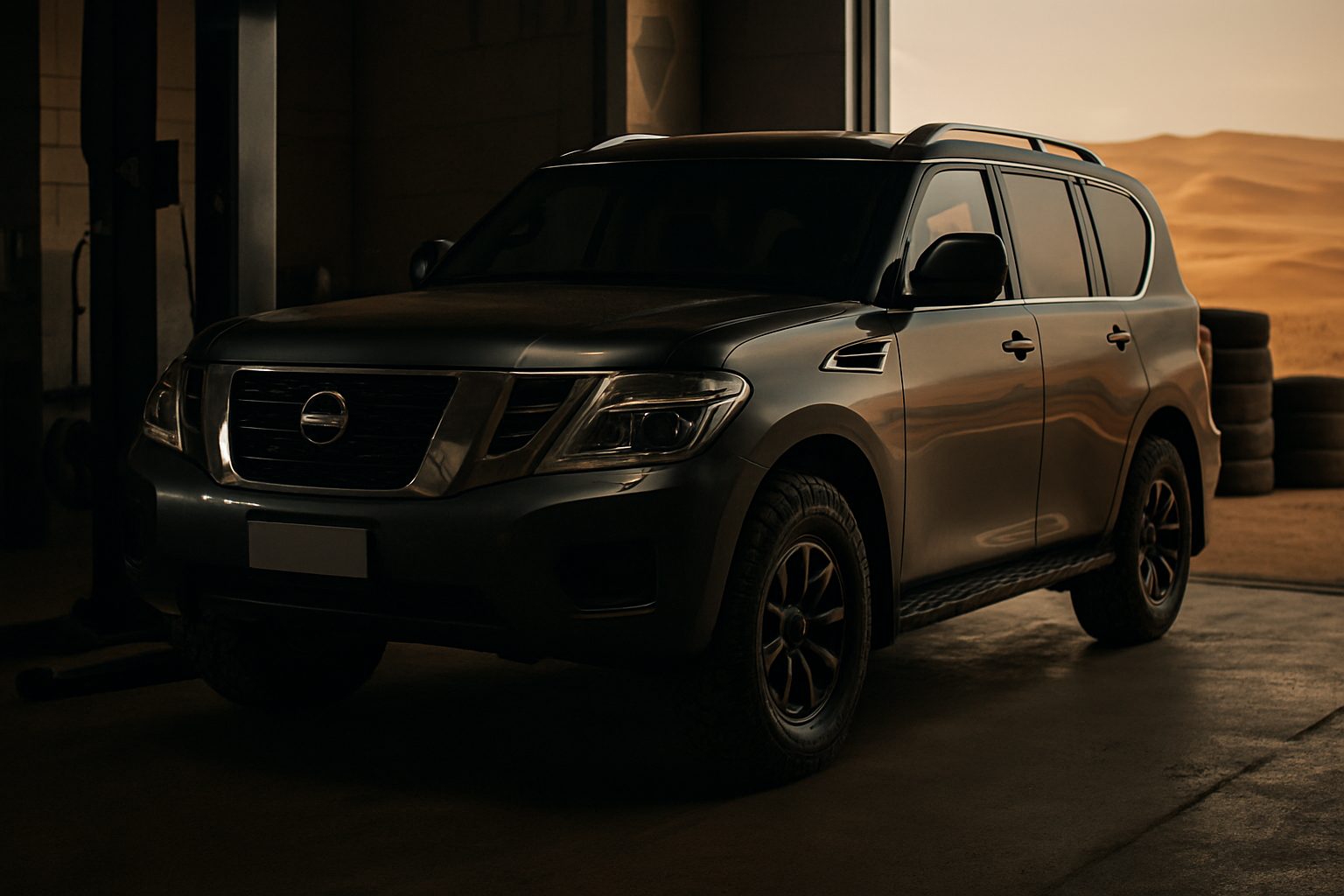
Part of: Preparing a Nissan Patrol Y62 for the Desert
Before a Y62 goes into the soft sand at Moreeb Dune or anywhere in the Liwa desert, the checks that matter most are cooling system condition, transmission fluid, tyre pressure, air filter cleanliness, and recovery gear. The Liwa trip adds a long highway leg before the sand, several days away from a workshop, and sustained dune running in extreme heat, so marginal items that hold up on a weekend run will not necessarily hold up here. Get the car checked before you leave, not after you arrive.
The Y62 has been doing desert work in the UAE since it launched here in 2010. In that time the failure patterns in deep sand have become predictable, and almost none of them are dramatic. A car does not usually strand its driver because something broke without warning. It strands them because something was already marginal and the desert pushed it past the limit. A cooling hose that has been sweating for months. Transmission fluid that smells faintly burnt on a clean day but shifts fine in traffic. A tyre with less tread than you thought, running softer than expected in the heat of soft sand. These are ordinary results of deferred maintenance meeting a hard day.
Liwa is not a weekend dune run. The drive from Abu Dhabi to Al Dhafra is long, and from Dubai it is longer. By the time the Y62 reaches the sand near Tal Moreeb, the engine and gearbox have already been working for a couple of hours at highway speed in high ambient temperatures. Add several days of back-to-back dune running, and the cumulative load is nothing like a morning at Big Red. December is the busiest time out there because the Liwa International Festival 2027 runs from 11 December 2026 to 3 January 2027. The sand is deep, the dunes are steep, and the cars are carrying gear and passengers for multi-day stays. What the vehicle needed going in is the full preparation below, not a quick check of the tyres at the petrol station.
What does the Y62 actually need before a Liwa trip?
It needs a cooling system in good condition, clean transmission fluid, correctly aired-down tyres at the sand entry point, a clean air filter, and working recovery gear on board. Those things, more than any modification or accessory, decide whether the car comes home under its own power.
The order matters too. Start with what strands a car fastest: the cooling system. Then the gearbox. Then suspension and tyres. Then filters and the smaller fluids. If you run out of time before the trip, the things you checked first are the ones that matter most. We have set the sections below in that order deliberately, because it is the same order we work through a car on the ramp.
Start with the cooling system
On a sustained dune run, the cooling system is what fails first if it has any weakness at all. For a car in Abu Dhabi, see our Abu Dhabi servicing.
On the highway, airflow through the front grille keeps the VK56VD running at a stable temperature even in 45-degree ambient heat. In soft sand at low speed, that airflow drops close to nothing. The engine is working hard, revs held high, the car barely moving up a dune face, and the cooling system has to carry all of that heat away with no help from forward motion. A thermostat that opens a little late, a hose with a small sweat at the collar, coolant that is due for a change: none of these matters on the road, and all of them matter in the dunes.
We check the coolant level and its condition, look at every hose under pressure and at rest, check the radiator cap seal, and look at the expansion tank for any signs of contamination. If the coolant is overdue or the colour has gone muddy, we flush and refill before the trip. A coolant failure in Al Dhafra is a long wait in the heat. It is not something to carry forward.
Check the transmission fluid before anything else moves
The gearbox takes the hardest sustained punishment of any component on a Liwa run, and the fluid is the first thing to show it.
The seven-speed JR710E is a torque-converter automatic. In soft sand it spends long periods hunting between ratios, slipping the converter, and generating heat it cannot easily shed. On a highway that heat dissipates quickly. On a dune face it builds. The fluid does the same job in a much hotter environment, for longer, with no recovery time between obstacles.
Dark fluid with a burnt smell means it has been running hot for a while, and fluid in that condition does not lubricate the same way clean fluid does. It is also telling you that the gearbox has already been running harder than it should. We pull the fluid, check the colour and smell, and look at the condition relative to the car's mileage and service history. On a higher-mileage gearbox, fluid that has been left too long between changes can contribute to early wear in the valve body. Where the service history is documented and the owner acts early, a fluid change is usually the whole job. The JR710E takes Matic S ATF, and getting that fluid in clean before a trip like this is straightforward and worth doing.
Every Y62 runs the same JR710E gearbox, so no car in the range has more thermal headroom than another. What changes is how the fluid has been treated over the car's life.
Tyres: pressure matters more than tread at Moreeb
Correct tyre pressure at the point of sand entry is what gives the Y62 its float across the surface, and getting it wrong is the single most common reason a capable car bogs down.
For the highway leg, run at normal road pressure. At the sand entry point, drop pressure to a level that spreads the tyre's contact patch across the surface without risking a bead separation at low speed. The right pressure for the sand depends on the sand type, the car's load, and the tyre size. We can tell you what works for your car specifically, because the answer is not the same for every setup.
Before the trip, check tread depth across the full width of all four tyres, not just the centre. Desert sand finds uneven wear and unpredictable handling is worse in deep sand than on road. Check sidewalls for any cracking, bubbling, or damage from previous off-road use. Carry a portable compressor and a tyre pressure gauge. You will need them to re-inflate before driving back onto tarmac, and if you pick up a slow puncture in the dunes you need to manage the pressure rather than just pull out and drive on it deflated.
A spare tyre in good condition is not optional. Carry one that matches the others.
The air filter and other fluids
A blocked air filter robs the VK56VD of power at exactly the moment you need it most, which is cresting a dune at low speed with the engine at full load.
Liwa's sand is fine. It gets into everything, and it loads up an air filter faster than coastal or city driving does. If the filter is already carrying dust from previous use, replace it before the trip. This is a quick job and an inexpensive one. Do not carry it forward.
While the air filter is being checked, we also look at the diff oil condition, the transfer case fluid, and the brake fluid. These are less likely to cause an immediate failure than the cooling system or gearbox, but a diff that is running low or carrying contaminated oil will whine and wear quickly under sustained desert load. Brake fluid absorbs moisture over time, and brakes that fade under heat are a problem on steep dune descents. These checks do not take long and they close gaps that would otherwise only show up when the car is hours from the nearest workshop.
Recovery gear and what to carry
Recovery gear is not an accessory for the Liwa desert. It is standard equipment.
At a minimum: a sand ladder or two, a tow strap rated for the car's weight, a shackle, a hi-lift jack or a dedicated sand jack, a portable compressor, and a shovel. The Y62 has the mass to dig itself in deep when it bogs, and a hi-lift jack on soft sand without a base plate is almost useless. Know how to use everything before you leave, and make sure whoever is with you does too.
A GPS device that works offline is worth having. Mobile coverage thins out in parts of Al Dhafra. Water for the occupants and water for a possible overheating event are both sensible. A basic first-aid kit and a full-charge power bank round out the minimum. None of this is dramatic preparation. It is just what the trip actually requires.
The HBMC suspension check
On Y62 trims fitted with the hydraulic body motion control suspension, a pre-desert check should include the system's condition and fluid level.
The hydraulic suspension absorbs repeated impacts on rough terrain, and it will tell you if something is wrong: the car will sit unevenly, or the handling will feel loose and roll-prone at angles that would normally feel planted. If the system has a slow leak or the fluid is low, the car will not control body movement the way it should on steep dune faces. We check the hydraulic fluid, look at the lines and connections for seepage, and confirm the system is operating correctly. This is a Y62-specific check that a general workshop may not prioritise, and it matters more on a trip like this than on ordinary off-road use.
Common questions from Y62 owners
How far in advance should I get my Y62 checked before a Liwa trip?
Bring the car in at least a week before you leave. That gives time to source any parts that are needed and do the work properly, rather than rushing a fluid change the day before the trip. If the car needs something beyond a standard fluid and filter check, a week is the minimum buffer. Two weeks is better.
Does the Y62 need any modifications to handle Moreeb Dune?
A stock Y62 in good mechanical condition can handle the soft sand around Moreeb Dune. The VK56VD has the torque, the ALL MODE 4x4 system manages the transitions well, and the suspension travel is adequate. What strands cars is deferred maintenance, not a lack of modifications. Get the car mechanically right first. Modifications come after that, and only if there is a specific reason for them.
Can I check the transmission fluid myself, or does it need a workshop?
You can check the fluid's colour and smell at the dipstick. Clean fluid is a clear red. Dark fluid with a burnt smell has been run too hard for too long. What you cannot check yourself is the actual condition of the fluid chemistry or the internal state of the gearbox. A workshop inspection gives you a much clearer picture of what the fluid is telling you and whether a change is the whole job or whether something else needs attention.
What do I do if the Y62 overheats in the dunes?
Stop immediately, put the car in park, and let it idle with the air conditioning off. Do not open the bonnet while the system is under pressure. Wait until the temperature gauge drops before investigating. If the coolant level is low, top it up only when the engine is cool. The underlying cause needs to be found and fixed before the car goes back into the sand: overheating once means something in the cooling system is not coping, and it will happen again under the same conditions.
Is it worth getting an inspection after the trip as well as before?
Yes. The damage from a Liwa run rarely shows up at the dunes. It shows up weeks later as a shudder at cruise, a whine from a diff, or a drip on the driveway. An inspection after the trip catches that damage while it is still straightforward to fix. Fluid that was clean going in can look very different after several days of hard desert running, and catching it early is the difference between a fluid change and a gearbox repair.
When should you book the car in?
We work on the Y62 and nothing else. Our workshop at Mussafah in Abu Dhabi is the closer of the two to Al Dhafra, and it sits on the route from Dubai as well, so it makes sense as a stop before the trip. Ras Al Khor in Dubai is there if that is more convenient for where the car is based. We handle Y62 servicing and repair at the Ras Al Khor workshop.
Send us the car's mileage, a note on its service history, and when the trip is. That tells us what to prioritise and how much time we have to work with.
Last updated: October 2026