
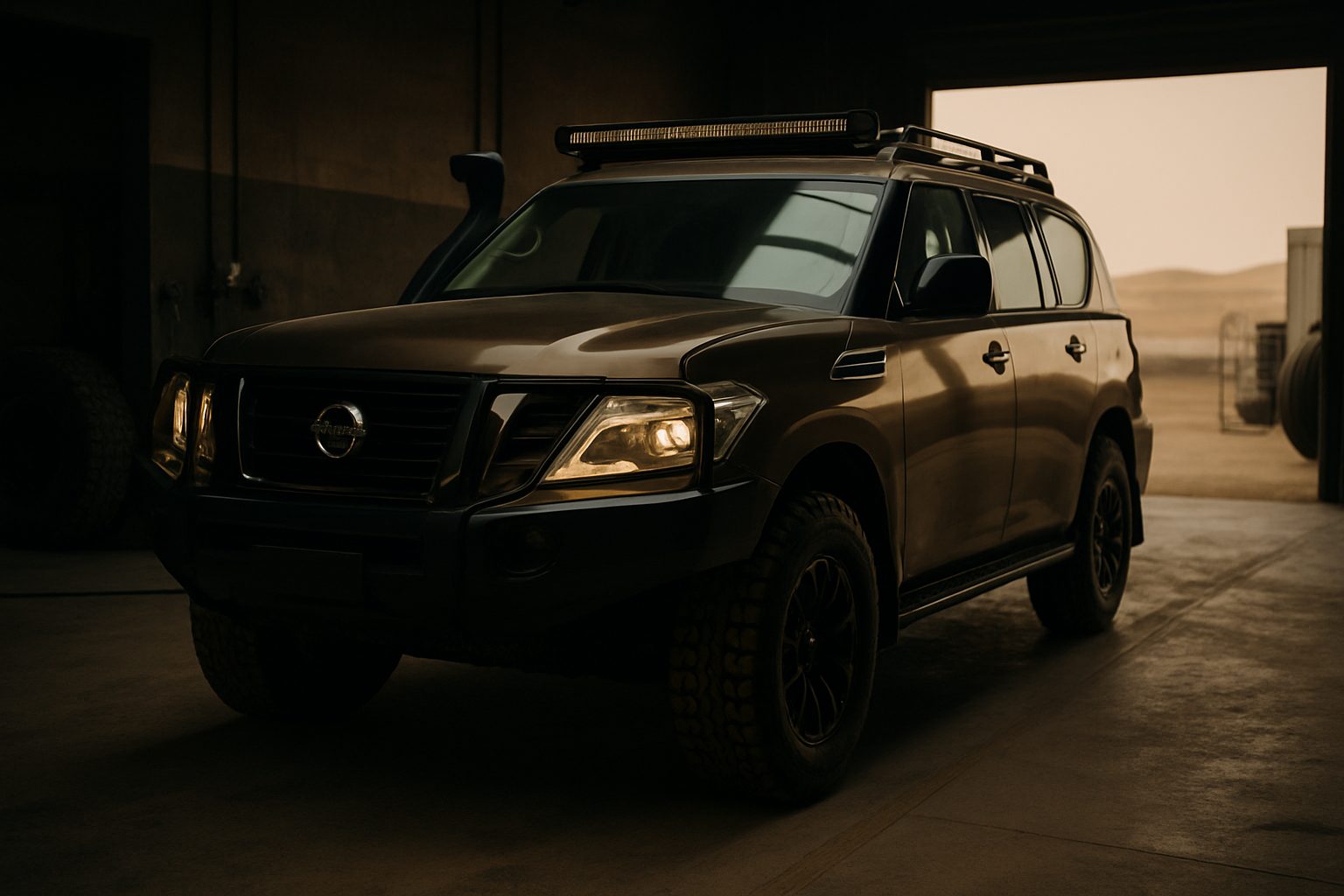
Before a Y62 goes into soft sand in UAE conditions, the checks that matter most are cooling system integrity, transmission fluid condition, tyre pressures, and air filter cleanliness. A car that is mechanically sound on tarmac can still overheat or get stranded on a long dune run, because the heat and load are nothing like daily driving. Work through the car in the order that keeps you moving: cooling first, then gearbox and transfer case, then suspension and tyres, then filters and fluids.
Al Dhafra is a long drive from either emirate, and Moreeb Dune is not a forgiving place to find out something was wrong before you left. The Y62 is genuinely capable in soft sand, the VK56VD V8 has the torque to pull through terrain that would stop most other wagons, and the ALL MODE 4x4 system handles mixed conditions well. But capable is not the same as invincible. A weekend of sustained dune running in 45-degree ambient heat puts a load on the cooling system, the transmission, and the suspension that no amount of highway driving replicates. What fails is almost always something that was already on its way out, running fine on the school run, until the sand found it. The checks below are ordered by what strands a car first. None of them require a ramp. Most take less than an hour at home. A few of them need a workshop visit, and we will say which ones plainly. Written by Top Challenger.
What does the Y62 actually need before a desert trip?
The Y62 needs a cooling system in good condition, transmission fluid that has not been overrun, aired-down tyres at the sand entry point, a clean air filter, and working recovery gear on board. Those five things, more than any accessory or modification, are what determine whether the car comes home under its own power.
The Y62 launched here in 2010 and has been doing desert work in the UAE ever since. In that time the failure patterns have become predictable. The car does not usually strand its driver because of a catastrophic failure. It strands them because something was marginal and the desert pushed it past the limit. A cooling hose that sweated for months without being touched. Transmission fluid that smells faintly burnt on the dipstick but shifts cleanly enough in traffic. A tyre that holds pressure on the road but loses it faster than expected in the heat of soft sand. These are not dramatic failures. They are the ordinary results of deferred maintenance meeting a hard day.
Cooling system: start here
The cooling system is the first thing to check because it is the first thing that can stop the trip. A VK56VD running hard through soft sand generates serious heat, and the fan and radiator work against ambient temperatures that leave almost no margin.
We check the coolant level and condition, the radiator cap, both top and bottom hoses, and the clamps. A hose that is soft, swollen, or shows surface cracks will not survive a desert day at high load. The radiator cap is cheap and often overlooked. A cap that cannot hold pressure drops the boiling point of the coolant and turns a marginal situation into an overheating event. We also look at the front of the radiator for compacted dust and debris. Dubai and Abu Dhabi traffic pack fine sand and bugs into the radiator core, and a blocked core reduces airflow at exactly the moment the engine needs it most.
If the temperature gauge has ever crept higher than normal in traffic, that is worth investigating before the desert, not after. A car that runs warm at 80 km/h on Sheikh Mohammed Bin Zayed Road will overheat on a long dune climb. The mechanism is the same, the conditions are just harder.
Gearbox temperature is the one owners underestimate most
Every Y62 runs the same seven-speed JR710E gearbox, and no car in the range has more thermal headroom than another. What varies is how far the car has run and whether the fluid has been looked after.
The JR710E runs hot on any sustained low-speed high-load work, and a long dune session is exactly that: repeated short climbs, frequent downshifts, stop-start recovery, the torque converter cycling constantly. Fluid that has been in the gearbox for a long time breaks down under heat, loses its viscosity, and starts to lose its ability to protect the clutch packs. By the time it smells burnt on the dipstick, it has been running hot for a while.
Nissan names the fluid for this gearbox as Matic S ATF and publishes no fill capacity and no change interval. Our own recommendation is to treat transmission fluid as a pre-desert check every time, not as something to revisit every fixed number of kilometres. Dark fluid with a burnt smell means change it before you go. Fresh fluid means you are good. That judgement is ours, not one we borrow from a published schedule, because no published schedule exists for this gearbox.
We also check the transfer case fluid at the same time. The ALL MODE 4x4 system takes its own fluid and it gets overlooked more often than the transmission. Running the transfer case dry or near-dry through a desert weekend damages it in ways that do not show up immediately and are expensive to fix.
Suspension: what the hydraulic system tells you on the drive in
The higher-trim Y62 runs Hydraulic Body Motion Control suspension, and it gives you information for free if you pay attention on the drive to the desert.
If the car feels unusual over rough tarmac on the way out, pulls to one side on a flat road, or sits noticeably lower on a corner, those are signals worth stopping for. The HBMC system interconnects the dampers hydraulically and any fluid loss affects how the car balances across all four corners. A leak that is invisible in the car park shows up as uneven behaviour under load. On dunes, that imbalance becomes a handling problem.
Even without the hydraulic system, we check all four shock absorbers for oil weeping down the body, and we check the bushings in the control arms for cracking. UAE heat ages rubber bushings faster than a temperate climate would, and a bushing that is cracked through does not cushion anything. Ball joints get checked too. A worn ball joint under dune-driving loads can fail suddenly, and that is not a recoverable situation on a dune face.
Tyre pressures and condition
Tyre pressure is the most immediate thing an owner can control, and getting it right makes the single biggest difference to whether the car floats across soft sand or digs into it.
Road pressure on the Y62 is typically in the 32 to 36 PSI range depending on trim and load. That pressure on soft sand turns the tyre into a cutting tool, which bogs the car immediately. For general dune driving in UAE conditions, dropping to around 14 to 18 PSI is where most drivers find the car works well. Deep, powdery sand calls for less. The tyre footprint expands as pressure drops, and that spread is what keeps the car floating instead of digging.
Deflate at the sand entry point before you need the float, not after you are already stuck. Carry a quality deflator and a 12V compressor capable of reinflating all four tyres before you return to tarmac. Driving back to the highway on aired-down tyres damages the sidewalls. At speed on a deflated tyre, heat builds fast.
Before deflating, check the sidewalls for cracks, bubbles, or anything that looks like it took an impact. A sidewall that is already compromised will not improve with the stress of soft-sand work.
Air filter and engine breathing
Desert air in Al Dhafra is not the same as Dubai motorway air. Fine suspended particles get into everything, and an engine breathing through a clogged filter loses power and runs richer to compensate.
We pull the air filter and check it before any desert trip. A filter that is dark grey on the incoming face is already working against the engine. In heavy dune conditions, a clean filter can load up in a single day. If the trip is long or the conditions are dusty, carrying a spare filter is worth the boot space it takes. Check the air box housing too, and the snorkel if one is fitted, for cracks or loose clamps where unfiltered air can bypass the filter entirely.
Engine oil is the other check that belongs here. The VK56VD takes 0W-20 — that is what the owner's manual for the Armada, which uses the same VK56VD, recommends. The owner's manual sets a 10,000 km or 12 month service interval. If the car is approaching either of those figures, do the oil change before the desert, not after. A desert day under load is harder on the oil than the equivalent distance on a highway, and fresh oil at the start of a hard trip is better than marginal oil at the end of one.
Recovery gear: what actually belongs in the car
Recovery gear is not optional in deep desert. A second vehicle and the right gear is what keeps a bogged car from becoming a stuck-until-dark situation.
At minimum: a shovel, a tow rope rated for the vehicle's weight, at least two rated shackles, a tyre deflator, a 12V compressor, and enough drinking water for everyone in the car. In summer, UAE desert air exceeds 45 degrees. Heat stress is common and water is not a luxury. Five litres per person is a real minimum for a day trip.
A high-lift jack is useful if you know how to use one safely. A set of sand boards or recovery tracks gives the tyres something to grip when digging out by hand is not working. Carry a charged phone and share your GPS coordinates and expected return time with someone who is not on the trip before you leave the tarmac. This is the instruction that sounds obvious and gets skipped most often.
Never drive alone. A single bogged vehicle in soft sand with no second car nearby is a situation that can go wrong quickly.
Common questions from Y62 owners
How often should I change the transmission fluid if I go to the desert regularly?
Nissan publishes no change interval for the JR710E gearbox, so there is no manufacturer figure to follow. Our own recommendation is to check the fluid condition before every desert trip. Dark colour and a burnt smell mean it needs changing before you go. If the car does regular desert work, we see fluid degrade faster than it does in pure highway use, and we treat condition as the trigger rather than a fixed mileage figure. If you want a number as a working ceiling, send us the car's mileage and service history and we can give you a direct answer for your specific car.
Do I need to do anything to the ALL MODE 4x4 system before a desert trip?
Engage 4H before the car reaches soft sand, not after you are already in it. For steep descents and recovery situations, 4L is the appropriate mode. Check that the transfer case fluid has been serviced: it is separate from the gearbox fluid and often missed in routine servicing. The ALL MODE system itself has no pre-trip adjustment, but making sure the fluid is clean and the system shifts correctly through all modes before you leave is worth five minutes in a car park.
What tyre pressure should I run on the Y62 at Moreeb Dune?
Moreeb is steep and the sand is fine and powdery at the base of the climb. It sits in the Liwa area, where the Liwa International Festival 2027 runs from 11 December 2026 to 3 January 2027, which is the reason a lot of Patrols get driven hard in December. Most experienced drivers in that area run at the lower end of the dune range, around 14 to 16 PSI, for the main face. The right pressure also depends on your tyre size, the load in the car, and how the car is behaving. If the car is pushing into the sand and losing momentum on a moderate slope, the pressure is likely still too high. Reinflate fully before returning to tarmac, and do not drive at highway speed on sand pressures.
My Y62 temperature gauge reads normal in traffic. Does it still need a cooling system check?
Yes. A cooling system can maintain normal temperatures under light load and still be marginal under the sustained hard load of a desert day. A weakened hose, a cap that will not hold pressure, or a partially blocked radiator core will not reveal themselves in stop-start traffic. They reveal themselves on a long dune climb at 46 degrees ambient. A pre-desert check is faster and cheaper than a recovery from the desert.
When to bring it to Top Challenger
We work on the Y62 and nothing else. The Ras Al Khor workshop covers cars coming from Dubai, and Mussafah in Abu Dhabi is the closer stop for anyone heading toward Al Dhafra and Moreeb Dune. We handle Y62 diagnostics and repair at the Ras Al Khor workshop.
Send us the car's mileage, a note on its service history, and when the trip is planned. We will tell you which checks are worth doing in person and what the car actually needs, not a generic list.
Last updated: September 2026