
Part of: Preparing a Nissan Patrol Y62 for the Desert
For most soft sand in the UAE, a Nissan Patrol Y62 runs well between 11 and 13 PSI. Mixed dune and hardpack terrain sits higher, around 14 to 17 PSI, and firm sabkha can take 17 to 21 PSI before the float benefit disappears. The right number for your car depends on your tyre size, how much weight you are carrying, and what the sand is doing that day, so treat those ranges as a starting point and adjust from there.
The Y62 has been doing desert work in the UAE since it launched here in 2010, and the physics of sand driving has not changed in that time. At road pressure, a tyre's contact patch is roughly the size of a postcard. Aired down to 12 PSI, that same tyre spreads across the sand like a wide, flat paddle, floating the car rather than letting it dig. The difference in traction is not subtle. It is the reason a well-set-up Y62 floats through terrain that buries other vehicles, and the reason so many recoveries happen to cars that drove onto soft sand without touching the valves first.
The VK56VD V8 gives the Y62 enough torque to muscle through when traction is marginal, but torque cannot replace float. Spinning a tyre at road pressure just digs a deeper hole. The ALL MODE 4x4 system distributes drive intelligently, but it is working with whatever contact patch the tyre is giving it. Air the tyres down first and the whole system has something to work with. Skip it and you are asking the electronics to compensate for a physics problem.
What follows covers how to pick the right pressure, what running too low actually does, how to bring the tyres back up safely for the road, and what to check on the car once you are back on tarmac. For the full pre-desert preparation sequence, including cooling system and transmission checks, the Y62 desert driving preparation post covers those in order.
What pressure should a Y62 run on soft sand?
Soft sand, the kind you find at Tal Moreeb or deep into Al Dhafra, calls for 11 to 13 PSI on a standard-loaded Y62. The finer and drier the sand, the lower you want to be within that range. Liwa's grains are some of the finest in the country. Pure quartz with no mineral binding means the surface shifts constantly underfoot. At those conditions, maximum contact patch is what keeps you moving.
A few things push you toward the higher end of the range. If the car is carrying extra passengers, a full load of camping gear, or a roof rack with weight on it, start at 13 PSI rather than 11. A heavier vehicle sinks further into soft sand and needs a slightly larger contact patch to compensate, which sounds counterintuitive until you remember that lower pressure on a loaded car also increases the risk of the bead unseating. If you are driving fast across open sand rather than picking through technical terrain, add a couple of PSI back. The tyre is under more lateral stress at speed and sidewall integrity matters more than maximum float when you are running hard across a flat.
Mixed dune terrain, the kind you get at Big Red or on the approach roads to deeper desert, is firmer and more varied. Here 14 to 17 PSI works for most Y62 drivers. The sand is compacted enough that you do not need maximum float, and the harder surface means you will catch occasional firm edges where a very soft tyre rolls unpredictably under cornering load. On firm sabkha, where the ground is almost like salt flat, 17 to 21 PSI gives enough float for any soft patches without the handling softness that comes with a very low pressure on a hard surface.
How low is too low
Below about 10 PSI on a non-beadlock wheel, the risk of the tyre bead separating from the rim becomes real. A separated bead on soft sand is recoverable but it ends the day. The tyre comes off the rim, the car sits on its axle, and getting it back on without proper equipment in the desert is difficult. The Y62's stock wheels are not beadlocks. That means 10 PSI is a reasonable floor, used only for short crawls or emergency recovery situations, and not as a general running pressure.
Running very low pressure at anything above slow crawling speed also stresses the sidewall in ways that do not always show immediately. Sidewall flex generates heat. At 45 degree ambient and full sun on black sand, that heat builds fast. A tyre that looks fine when you stop may have sustained internal damage to the carcass that only shows later, sometimes on the highway home. This is why the re-inflation step before returning to tarmac matters as much as the deflation step at the start.
Deflate before you enter the sand, not after you get stuck
The deflation point is the tarmac edge, not the first dune. Driving onto sand at road pressure and then stopping to air down when you feel the car struggling means you have already used momentum and you are now parked in the terrain. Doing it at the road also lets you walk around the car and check the pressures evenly across all four corners before you commit.
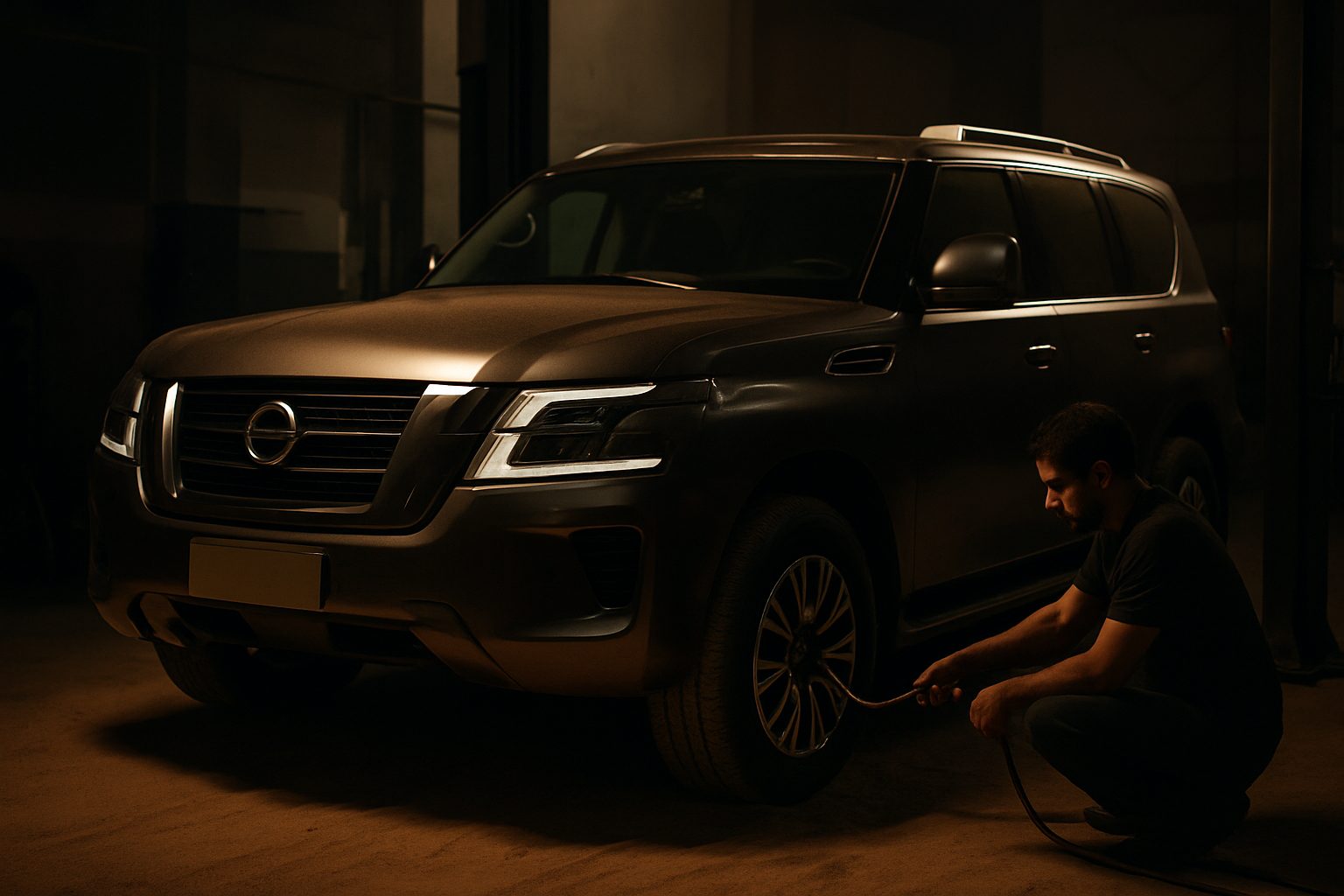
A quality tyre deflator makes this faster and more accurate than removing valve cores by hand. Removing a core gives a faster bleed but loses the core in the sand regularly enough that it is worth mentioning. A deflator tool with a built-in gauge lets you bleed to a target and check at the same time. Do all four tyres, check each one again with a separate gauge if the deflator's gauge is the kind that bounces around under pressure, and then drive in.
Engage the ALL MODE 4x4 system before the sand entry point too. The system handles mixed conditions well but it is not something you want to be adjusting once you are on a moving dune face.
The tyre pressure monitoring system will warn you, and that is expected
The Y62's TPMS will read low tyre pressure as a fault and the warning light will come on when you air down. That is the system working correctly. Do not be alarmed by it at the sand entry point, and do not try to reset it before you go back on tarmac. Once you re-inflate to road pressure after the desert run, the warning should clear on its own as the sensors register the correct pressure. If it does not clear after a few kilometres of driving, the sensor itself may need attention.
TPMS sensors on a Y62 used regularly for desert driving take more abuse than most. Repeated deflation and inflation cycles, sand ingress around the valve, and the heat of a summer desert run all shorten their working life. If a sensor is reading intermittently or not clearing after correct re-inflation, that is worth checking at the workshop before the next trip rather than ignoring it. A failed sensor means you have no warning if a tyre actually loses pressure on the highway home.
Re-inflate before you return to tarmac
Driving at 80 km/h or above on a tyre running at 12 PSI will destroy the sidewall. The flexing that makes low pressure useful in sand becomes catastrophic on hard tarmac at speed. The tyre overheats, the carcass breaks down, and the result is a blowout. This is not a gradual failure. It can happen within kilometres.
Carry a 12V compressor rated for the Y62's tyre size. A compressor that is adequate for a small SUV may take 20 minutes per tyre on a Patrol's volume, which is long enough to overheat the compressor and leave you with half the car re-inflated and a dead unit. Check the compressor's continuous duty rating before you rely on it for a four-tyre re-inflation on a hot afternoon. Do the re-inflation in the shade if possible. Sand-temperature heat on the tyre surface at the same time as the compressor is running hot is not a good combination.
Re-inflate to your normal road pressure. Check the figure on the tyre placard on the driver's door jamb rather than going by memory. Then drive a short distance and check the pressures again, because tyre temperature affects the reading and the first check is always on a hot tyre from the desert run.
What to check on the car after a desert run
Once the car is back on tarmac and before the next trip, a few checks are worth doing. Sand gets into places that matter.
- Check the tyre sidewalls visually for bulges, cuts, or abrasion. Soft sand looks benign but a half-buried rock edge can score a sidewall without the driver feeling it.
- Check the valve stems. The valve core should be seated correctly and the cap should be on. A valve stem that has been leaking slowly can leave you with an underinflated tyre days after the trip.
- Check the air filter. The VK56VD breathes hard under load and the desert generates fine dust that gets through gaps that road driving would not expose. A partially blocked filter shows up as a slight loss of response under load.
- Check underneath for packed sand around the underbody, particularly around the exhaust and the differential cases. It holds heat and moisture, both of which accelerate corrosion on a car that also sees coastal humidity.
- Check the transmission fluid condition. A desert run with multiple high-load climbs puts real heat through the gearbox. Fluid that smells faintly burnt after the run was already close to the limit before it. The JR710E takes Matic S ATF, and fluid that has been run hot loses its protective properties faster than distance alone would suggest.
The HBMC hydraulic suspension fitted to higher Y62 trims is also worth checking if the car felt different on the highway home. Sustained off-road use can expose a slow leak that road driving masks.
Common questions from Y62 owners
Do I need different pressures for Liwa compared to Big Red?
Yes, and the difference is the sand itself. Big Red is compacted, orange-red sand with firm sections between the dune faces. Liwa's deep desert is much finer, softer, and more powdery, particularly around Tal Moreeb. For Liwa you want to be at the lower end of the soft-sand range or even slightly below it if conditions are very fine. At Big Red you can usually stay in the mixed-dune range and be fine. The other variable is load: a fully packed car for a multi-day Liwa trip weighs more than a day-trip vehicle, which pushes the ideal pressure up slightly even on the same sand.
Can I leave the tyres partially aired down for the drive between dune sections?
If the connecting road is unpaved sand or graded track and the speed is low, yes. If it is tarmac, even a short stretch at highway speed, re-inflate first. The damage happens quickly at speed on a low-pressure tyre. A portable compressor in the car means the transition takes a few minutes each way, which is always the better trade-off compared to a destroyed tyre on the highway.
My TPMS light stayed on after I re-inflated. What does that mean?
Usually one of two things. Either one tyre is not quite back to the correct pressure, which a gauge check will confirm, or a TPMS sensor has not reregistered correctly after the pressure change. Drive a few kilometres and check again. If the light is still on and the pressures are correct, the sensor itself may need attention. Sensors on cars used regularly in sand are worth checking as a matter of course, because the conditions accelerate wear on both the sensor and the valve assembly.
Does the tyre size on my Y62 change the right pressure for sand?
It does. A larger tyre by diameter or width has more contact patch at the same PSI, so on a tyre upgrade you can sometimes run slightly higher than the ranges above and still get adequate float. The load rating also changes. If you are running an aftermarket tyre that is larger or heavier duty than the stock fitment, the floor pressure before bead risk shifts as well. The ranges in this post are a starting point for the standard tyre fitment. If you have changed tyre size, adjust from there and test conservatively.
When should you bring the car in?
We specialise in the Nissan Patrol Y62, with workshops in Ras Al Khor in Dubai and Mussafah in Abu Dhabi. Mussafah is the closer of the two for anyone heading toward the desert, which makes it a practical stop for a pre-trip check or a post-desert inspection. We handle Y62 diagnostics and repair at the Ras Al Khor workshop.
If you want the car looked over before a desert trip, send us a message on WhatsApp with what the trip involves and the car's current mileage. We will tell you what to check and whether anything needs doing before you go. If the car has come back from a hard run and something feels different, or the transmission fluid is darker than it should be, or the TPMS is not clearing correctly, the same applies. Tell us what the car is doing and when you need it ready.
Last updated: October 2026