
Part of: Nissan Patrol Y62 Suspension and HBMC Problems in Dubai
What you pay for suspension work on a Nissan Patrol Y62 in Dubai depends on which components need replacing, whether your car has the Hydraulic Body Motion Control system, and how long the problem has been left. A creak caught early is usually one or two bushes. A knock that has been present for months often means the damage has spread to adjacent joints, or the hydraulic circuit has been working against a degraded component the whole time. Send us a description of what the car does and which corner it comes from, and we will tell you what it is likely to need before you drive in.
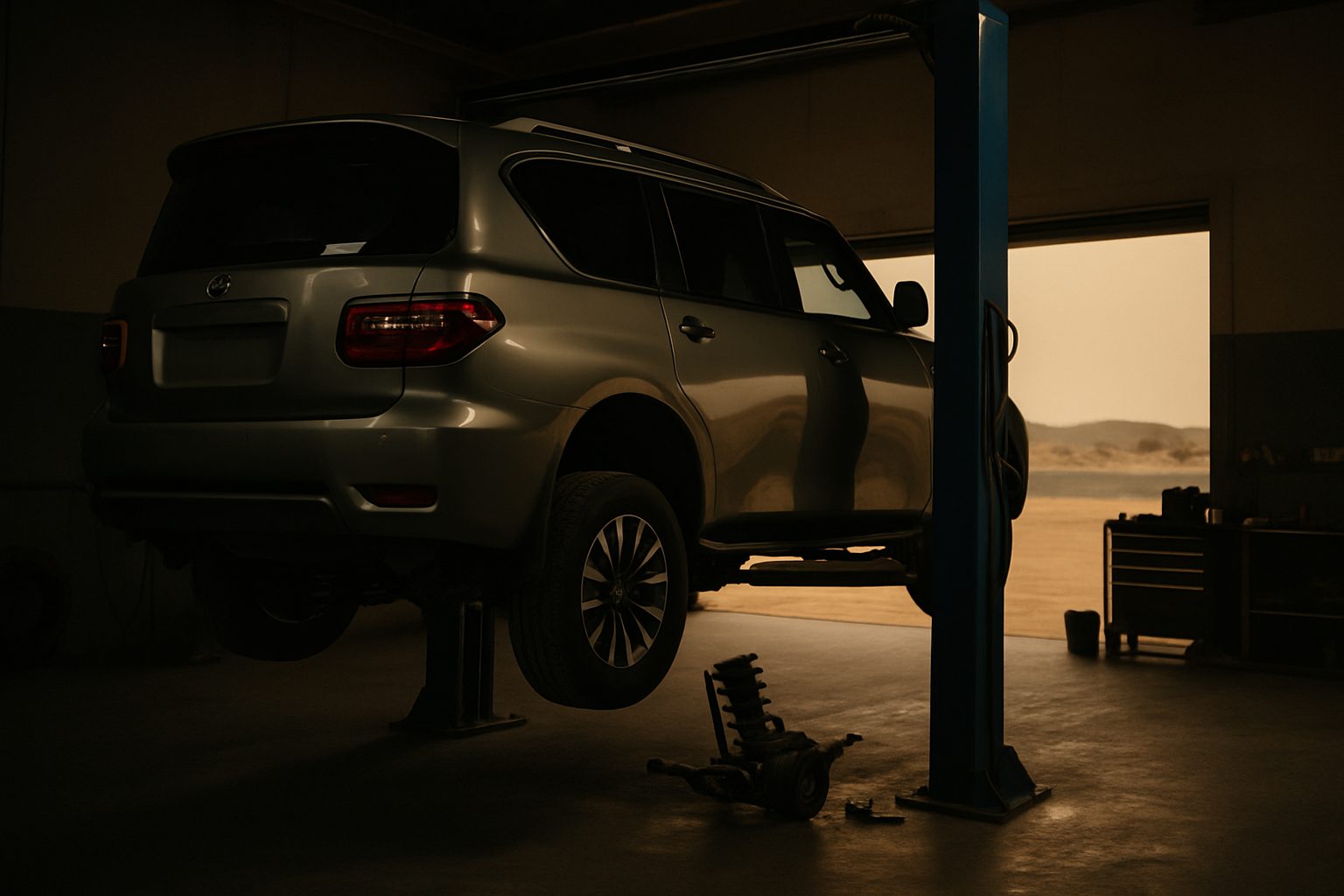
Suspension complaints on the Y62 are the most common thing we see after gearbox work. The car is heavy, it runs on roads that reach 50 degrees Celsius in summer, and a large share of owners take it off-road in Al Qudra or Liwa regularly. Sand and fine dust work into rubber bushes faster than road grit does, and the hydraulic fluid in the body motion control system on higher-trim cars degrades in heat at a different rate than a conventional damper wears. The result is that two Y62s can arrive with the same complaint, a knock over bumps, and need completely different work. One might need a drop link. The other might need the HBMC accumulator tested and a damper replaced on the same corner. Getting the diagnosis right before anything is touched is the whole job, and it is why we put the car on the ramp before we quote.
What does suspension repair on a Y62 actually cost?
The cost is determined by what the inspection finds, not by the symptom the owner describes.
Three things set the price on any suspension job: which parts need replacing, whether those parts can be rebuilt or must come out as assemblies, and how much labour is involved in reaching them. On the Y62, a bush replacement on a control arm is a straightforward job. Replacing a damper on a car with HBMC takes longer because the hydraulic lines are part of the circuit, not just attached to the corner. Geometry work adds time again, because a car that has been used hard in sand often has alignment that has shifted, and that needs correcting after new components are fitted or the tyres will wear unevenly within a few thousand kilometres.
We do not quote a flat rate for suspension repair because the job changes too much between cars. Describe what the car does and we will tell you what we expect to find. A proper quote follows once it is on the ramp and we can see the condition of the joints and fluid.
The symptom you describe tells us where to start
The noise an owner hears in the cabin is almost never coming from the component directly beneath them, which is why we do not guess from a description alone. This is the work we do as Y62 suspension and HBMC repair.
A faint creak over speed bumps at low speed, with no change in how the car sits or steers, usually points to a bush that is dry or starting to split. It is worth booking in, but it is not urgent. A knock that has appeared over the last few weeks, especially if one corner sits lower than the others or the tyres are wearing unevenly on one side, points to something that has been moving for a while and has probably affected the geometry. A clunk you can feel through the steering wheel narrows it further toward the front control arms or ball joints.
On HBMC-equipped cars, a soft or vague feeling over bumps, where the car feels disconnected rather than harsh, can be the hydraulic circuit losing pressure rather than a mechanical component failing. The accumulator, the pump, and a tired damper can all produce the same complaint from the driver's seat. That is the reason we test the hydraulic circuit as a circuit before we condemn any individual part. Replacing a damper on a car whose real problem is a leaking accumulator fixes nothing.
What we check first, and why that order matters
Wheels off, every joint by hand, before anything is quoted or replaced.
We start with the bushes, ball joints, drop links, and mounts, checking each one individually for play. Then we look at the dampers for signs they are weeping fluid rather than simply worn. A damper that is weeping will show an oily residue on the body; one that has lost its damping but is not leaking looks fine from the outside. You need to feel the spring control to catch the second type.
Ride height across all four corners comes next, because a corner that sits low either has a settled spring or a hydraulic problem, and those are different repairs. Then the tyre wear pattern, which tells you whether the geometry has moved. Uneven wear across the width of a tyre points at camber. Wear on the inside or outside edge that developed quickly after the car was used in sand points at toe that has shifted.
On cars with the VK56VD engine and higher mileage, we also check whether the car has been run in low range regularly, because sustained low-range use in sand puts different loads on the front suspension than road driving does. Bushes on those cars wear from a different direction, and the inspection reflects that.
Want this checked on your own car rather than in general?
Get it quoted on WhatsAppHow the hydraulic suspension changes the diagnosis
A standard Y62 and an HBMC-equipped Y62 need different diagnostic sequences, even when the complaint sounds identical.
The Hydraulic Body Motion Control system uses hydraulic fluid to link the corners and resist body roll. A slow accumulator, a weak pump, and a tired damper can all make the car feel vague or unsettled over a bump. From the driver's seat, those three things are indistinguishable. On the ramp, they are not. We test the hydraulic circuit, fluid condition, and pressure before we touch any individual component. If the fluid is degraded, that gets addressed first, because contaminated fluid damages every component downstream of it and will shorten the life of any new parts we fit.
The consequence of getting this wrong is real. A damper that is condemned and replaced when the actual problem is hydraulic pressure will feel better for a short time and then return the same complaint. The owner pays for a damper they did not need. We would rather spend time on the diagnosis.
What happens when a suspension problem is left too long
A worn bush does not simply wear itself. It changes the load on every joint next to it.
When a bush loses its elasticity and starts to move, the ball joint on the same arm begins to carry load it was not designed for. The geometry shifts, usually in ways that are too small to feel at first, but large enough to wear the tyres unevenly within a few thousand kilometres. By the time an owner notices the tyre wear, the ball joint is often compromised as well. What started as one component is now two, sometimes three.
On HBMC cars the consequence of delay is more expensive. The hydraulic circuit runs at pressure continuously, and a component that is partially failed puts the pump and accumulator under elevated load. Heat in UAE conditions accelerates that degradation faster than it would in a cooler climate. A problem that costs one amount in January, when the owner first notices the creak, costs considerably more in July after a season of 45-degree days and regular dune runs.
Service history and mileage: what actually predicts the condition of the suspension
The condition of the suspension correlates with mileage and use history, not with the calendar year the car was built.
Cars at high mileage that have been serviced regularly and used primarily on tarmac often have suspension in reasonable shape because the loads have been consistent and the rubber has not been stressed by sand. Cars at moderate mileage that have done regular soft-sand driving can have bushes that look fine from the outside but have absorbed grit and are starting to move. We cannot tell which one we have until the wheels come off.
If you know the car has been in Liwa or Big Red regularly, tell us when you book in. It changes where we look first, and it changes how we interpret the wear patterns we find. A car with a documented service history that is showing early symptoms will usually need less work than one where the history is incomplete and the symptoms have been present for a while.
Does the hydraulic suspension cost more to repair than standard dampers?
Generally yes, because the diagnosis takes longer and the components are more complex. A standard damper is one part. An HBMC system is a circuit, and we test the whole circuit before we replace anything. If the problem is the accumulator rather than the damper, those are different parts at different prices. The only way to know which one your car needs is to put it on the ramp and check.
Can I drive the car if it is making a knocking noise?
A faint creak at low speed over bumps is usually a dry or splitting bush, and the car is safe to drive short distances to get it diagnosed. A clunk you can feel through the steering, or a corner that sits lower than the others, means the geometry has likely moved and the car should not be driven until it has been checked. Uneven geometry puts uneven load on the tyres and the remaining joints, and that can turn a modest repair into a larger one.
How often do the suspension bushes need replacing on a Y62 used in the desert?
There is no fixed interval we can name, because it depends on how much soft-sand driving the car does and at what tyre pressures. We treat it as a condition-based check rather than a mileage trigger. What we will say is that a Y62 used in soft sand regularly will go through bushes faster than one kept on tarmac, and the first sign is usually a creak over low-speed bumps rather than anything dramatic. If you are doing regular dune runs, have the front suspension checked by mileage rather than waiting for a noise.
Will fixing the suspension affect the wheel alignment?
Almost always yes, which is why alignment is the last step rather than an optional extra. Replacing a control arm bush changes the geometry slightly, and on a car that has been running with worn components for a while, the alignment will have already moved. We check ride height and geometry after any suspension work and correct it before the car leaves. Putting new parts on a car with the same misalignment just means the new parts wear in the same pattern as the old ones.
When to bring it to Top Challenger
We work on the Y62 and nothing else, at Ras Al Khor in Dubai and Mussafah in Abu Dhabi. Both workshops do the same suspension work, so whichever is easier for you is the right choice. Message us on WhatsApp with what the car is doing and which corner the noise is coming from, and we will tell you what we expect before you arrive. We handle Y62 suspension work at the Ras Al Khor workshop.
Last updated: September 2026