
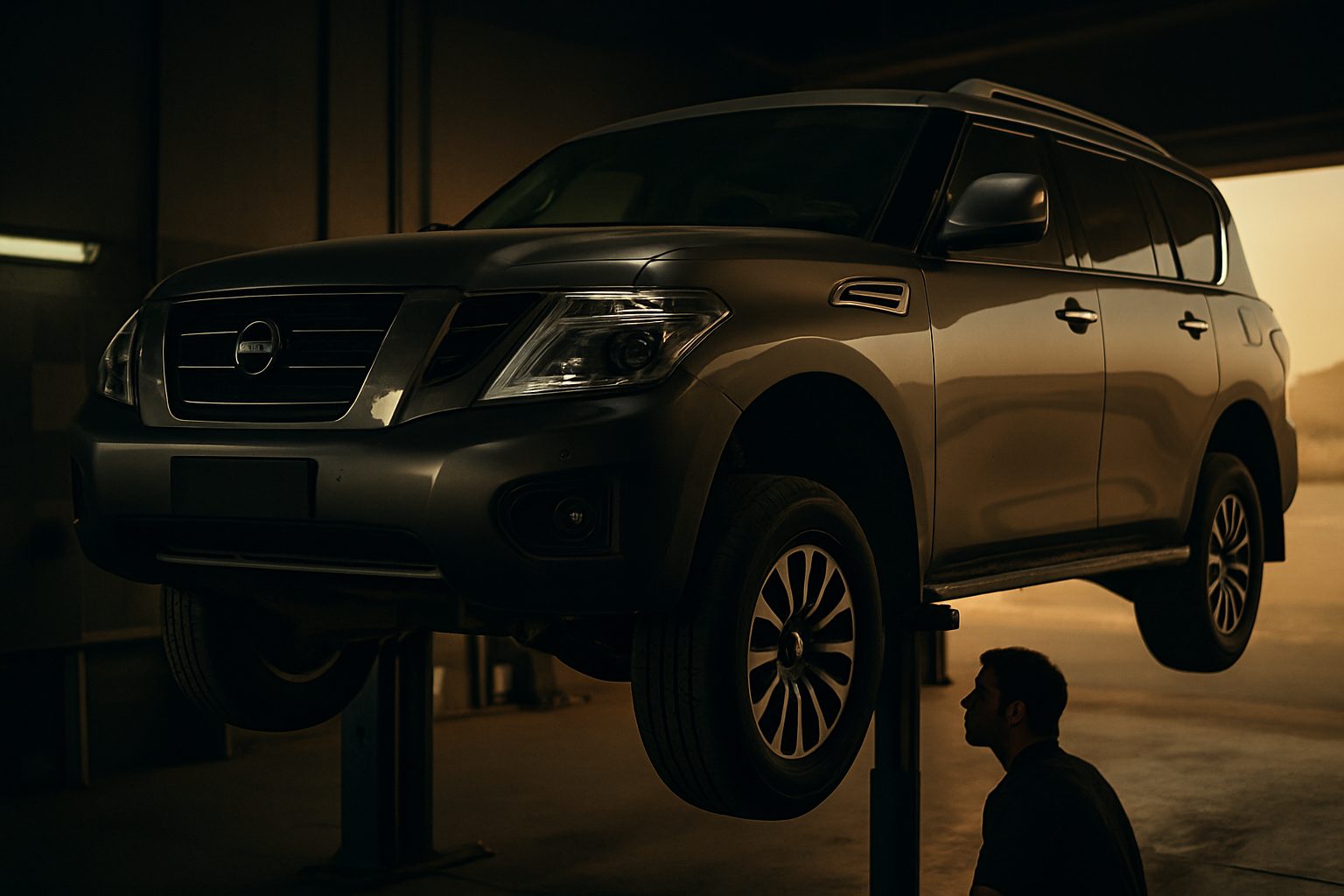
Part of: Nissan Patrol Y62 Suspension and HBMC Problems in Dubai
A knock or creak from a Nissan Patrol Y62 over speed bumps is most often a worn bush, a loose drop link, or a damper that has stopped controlling the spring properly. On cars fitted with Hydraulic Body Motion Control, a slow accumulator or degraded hydraulic fluid can produce exactly the same sound, which is why the diagnosis matters before anything is replaced. Tell us which corner the noise comes from and what the road surface does to change it, and we can usually tell you what to expect before the car arrives.
Speed bumps are the suspension's lie detector. At low speed, with the body settling slowly over the hump, every loose joint and tired damper has nowhere to hide. A noise that disappears on smooth tarmac and comes back reliably over the speed bumps at a car park exit is almost never random. It is a component telling you something specific, and the component making the noise is often not the one you would point to from inside the car. The Y62 is a heavy vehicle. It launched in the UAE in 2010 and has been used hard here ever since, on roads that reach 45 to 50 degrees Celsius in summer and on sand that works into rubber bushes far faster than road grit does. Stop-start traffic on Sheikh Zayed Road and weekend runs to Al Qudra and Liwa load the suspension in different ways, and both leave marks. The good news is that suspension noise caught early, when it is still a faint creak, is usually one or two bushes. Left until it becomes a clunk you can feel through the seat, the damage has often spread to adjacent joints, and what was a straightforward job becomes a longer one.
What kind of noise is your Y62 making over bumps?
The character of the noise tells you roughly where to look before the wheels come off.
A creak at very low speed, almost like stressed wood, points toward a dry or cracked rubber bush. The bush is not failing catastrophically, but it has lost its elasticity and is moving against metal rather than absorbing it. You will often notice it most at walking pace over a car park hump, and it fades when the car is moving faster because the dynamics change.
A single knock, short and sharp, each time the wheel drops off a bump suggests a drop link or a ball joint with play in it. The joint is not cracked; it has a small amount of movement it should not have, and the bump loads it just enough to produce the clunk. These are the noises owners describe as "something loose."
A thud that you feel through the floor as well as hear is more often a damper that is no longer doing its job. The spring compresses and rebounds without being controlled, and the thud is the body arriving back rather than being guided back. On a car with Hydraulic Body Motion Control, a weak accumulator produces something similar, because the hydraulic circuit is not damping body roll the way it should.
A creak that changes with steering input, or that appears only when turning and going over a bump at the same time, narrows it toward the upper strut mount or a ball joint loaded by steering angle. That combination is useful information.
The hydraulic suspension on higher-trim Y62s changes how we diagnose
On cars fitted with Hydraulic Body Motion Control, the system has to be tested as a circuit before any individual part is condemned. This is the work we do as our Y62 suspension work.
HBMC links the four corners hydraulically to resist body roll. The fluid runs through actuators at each corner, and the circuit relies on the accumulator holding pressure and the pump maintaining it. When any part of that circuit degrades, the symptom at the driver's seat is a change in how the car feels over bumps: more float, a clunk on one side, or the sense that the body is not being held. That is exactly how a tired damper presents. Replacing a damper on a car whose real problem is a slow accumulator fixes nothing, and the owner is back with the same noise a week later.
We check the hydraulic fluid condition and the accumulator pressure before we look at the dampers on any HBMC car. The fluid degrades in sustained heat at a rate a conventional damper oil does not, and a car that has been used hard in summer without the circuit being serviced will often show pressure drop before anything has actually broken mechanically. Once we know the circuit is holding, we can assess the dampers properly. That order matters.
What we check first, and why that order
The wheels come off before anything is concluded. A noise heard from the driver's seat travels through the chassis, and the component making it is rarely where the sound seems to come from.
We work through the car in a consistent sequence. Every bush, ball joint, drop link, and mount is checked by hand for play. A bush that looks intact from the outside can be delaminated internally, and you only know that when you load it by hand with the wheel off. Drop links are quick to check and fail often, particularly on cars that see regular off-road use, because the angle they operate at in sand is different from what they see on tarmac.
After the joints, we look at the dampers. A damper that is weeping will show fluid on the body. One that has lost its internal resistance will not look like anything from outside, which is why we check travel and control rather than just looking for leaks.
On HBMC cars, the hydraulic circuit is tested at this point, before any parts are priced. Ride height across the four corners is measured, because a corner that has settled tells you something about the spring or the hydraulic pressure at that corner. Tyre wear pattern comes last in the visual sequence, because uneven wear across the face of a tyre points at geometry that has shifted, usually because a bush has allowed a control arm to move off its designed position.
We also ask the owner how the car is used. A Y62 that runs in soft sand regularly has bushes and seals that wear at a different rate from one that stays on tarmac. That context changes what we expect to find.
Bush and drop link wear: the most common source of the noise
Worn bushes and drop links are behind the majority of Y62 speed bump noises we work on.
The rubber bushes in the control arms allow the suspension to move through its travel while keeping everything aligned. In the UAE, fine sand and dust get into the joint over time, and the rubber dries and cracks faster than it would in a cooler, less dusty climate. A bush that has cracked will creak under load. A bush that has lost its rubber entirely, leaving metal moving against metal, will knock. The difference in sound is usually a difference in how long the problem has been present.
Drop links connect the anti-roll bar to the suspension. They are small and relatively inexpensive, and they fail more often than most owners expect, partly because the Y62 is a heavy car and the lateral loads through the drop link on a rutted desert track are significant. A failed drop link produces a knock that appears over bumps and also when the car leans through a corner. Both movements load the same component.
Where the service history is documented and the car comes in early, a bush or drop link replacement is usually the whole job. Where the car has been running with the noise for a long time, the play in the worn component often allows adjacent joints to wear unevenly, and the job grows.
What rear camber and alignment have to do with bump noise
A suspension noise that is accompanied by uneven tyre wear is telling you the geometry has moved, not just that a component is worn.
The Y62's independent rear suspension holds its geometry through the condition of the bushes and control arms. When a bush wears, the control arm it mounts to can move slightly off its designed position. The result is a change in rear camber or toe, and you see it first in the tyre: wear on one edge that does not match the other side. By the time the tyre wear is visible, the alignment has been wrong for a while.
This is worth knowing because owners sometimes assume that a noise over bumps and uneven tyre wear are two separate problems. Usually they are the same problem seen from different angles. We check geometry after replacing any bush or control arm, because fitting new components into misaligned geometry is a way of wearing the new parts unevenly from day one.
What it costs to leave suspension noise alone
The financial case for acting early is straightforward: a worn bush does not stay a worn bush.
A drop link with play loads the anti-roll bar mount differently with every bump. A cracked bush lets the control arm move in a way the ball joint was not designed to accommodate, and ball joints are more expensive than bushes. A damper that has stopped controlling the spring allows the body to move further than it should on every road input, which loads every other joint in the corner on each cycle. The wear spreads outward from the original failed component, and the job that was one part becomes several.
On cars with Hydraulic Body Motion Control, degraded fluid left in the circuit does something similar: the accumulator works against pressure it cannot maintain, the pump cycles more often than it should, and by the time the owner books the car in, the circuit needs more than a fluid service.
We do not quote suspension work as a flat rate because the job changes too much between cars. The inspection tells us what is actually there. What we can say is that the inspection itself, done before anything is replaced, is always cheaper than replacing the wrong part first.
Common questions from Y62 owners
Why does my Patrol only make the noise at low speed over speed bumps and not on normal roads?
Low-speed bump traversal loads the suspension through its full travel slowly, which puts maximum stress on bushes and joints at exactly the point where a worn component reveals itself. At higher speeds on smooth tarmac, the loads are distributed differently and the same loose joint may not move enough to produce a noise. A creak or knock that appears specifically over slow speed bumps is a reliable indicator of a bush or joint fault, not a random noise.
Can I tell which corner the problem is on without putting the car on a ramp?
The corner the noise comes from is useful information and worth noting before you bring the car in. A knock from the front left over every bump points us there first. That said, noise travels through the chassis, and what sounds like a front corner can originate at the rear on some configurations. The corner you identify is a starting point, not a diagnosis. We confirm it with the wheels off.
My Y62 has the hydraulic suspension. Is a knock over bumps more serious on that system than on a standard setup?
Not necessarily more serious, but the diagnosis takes longer because the hydraulic circuit has to be tested before individual components are condemned. A knock on an HBMC car can be a bush or a drop link, exactly as on a standard setup. It can also be a pressure problem in the hydraulic circuit, which presents identically from the driver's seat. We test the circuit first so we know which one we are dealing with before anything comes off the car.
How much does Y62 suspension work cost?
The cost is set by what the inspection finds, not by the symptom. A single bush or drop link is a different job from a damper replacement on a car with Hydraulic Body Motion Control, and both are different again if geometry work is needed afterwards. Send us a description of what the car does and which corner it comes from, and we will give you a realistic expectation before you drive in. A firm quote follows once the car is on the ramp and we can see what is actually worn.
The noise appeared after a weekend in the desert. Is off-road use likely the cause?
Off-road use accelerates bush and seal wear because fine sand is abrasive and the suspension operates at angles and loads it rarely sees on tarmac. A noise that appears after a desert run is not unusual. It may mean a component that was already marginal has now failed, or it may mean something has been displaced by a hard impact. Either way it is worth checking sooner rather than later, because off-road loads that have cracked one bush tend to have stressed the adjacent ones too.
When to bring it to Top Challenger
We work on the Y62 and nothing else, at Ras Al Khor in Dubai and Mussafah in Abu Dhabi. Send us a message on WhatsApp describing the noise, which corner it comes from, and roughly how long it has been there. We will tell you what it is likely to need before you make the trip. We handle Y62 servicing and repair at the Ras Al Khor workshop.
Last updated: October 2026