
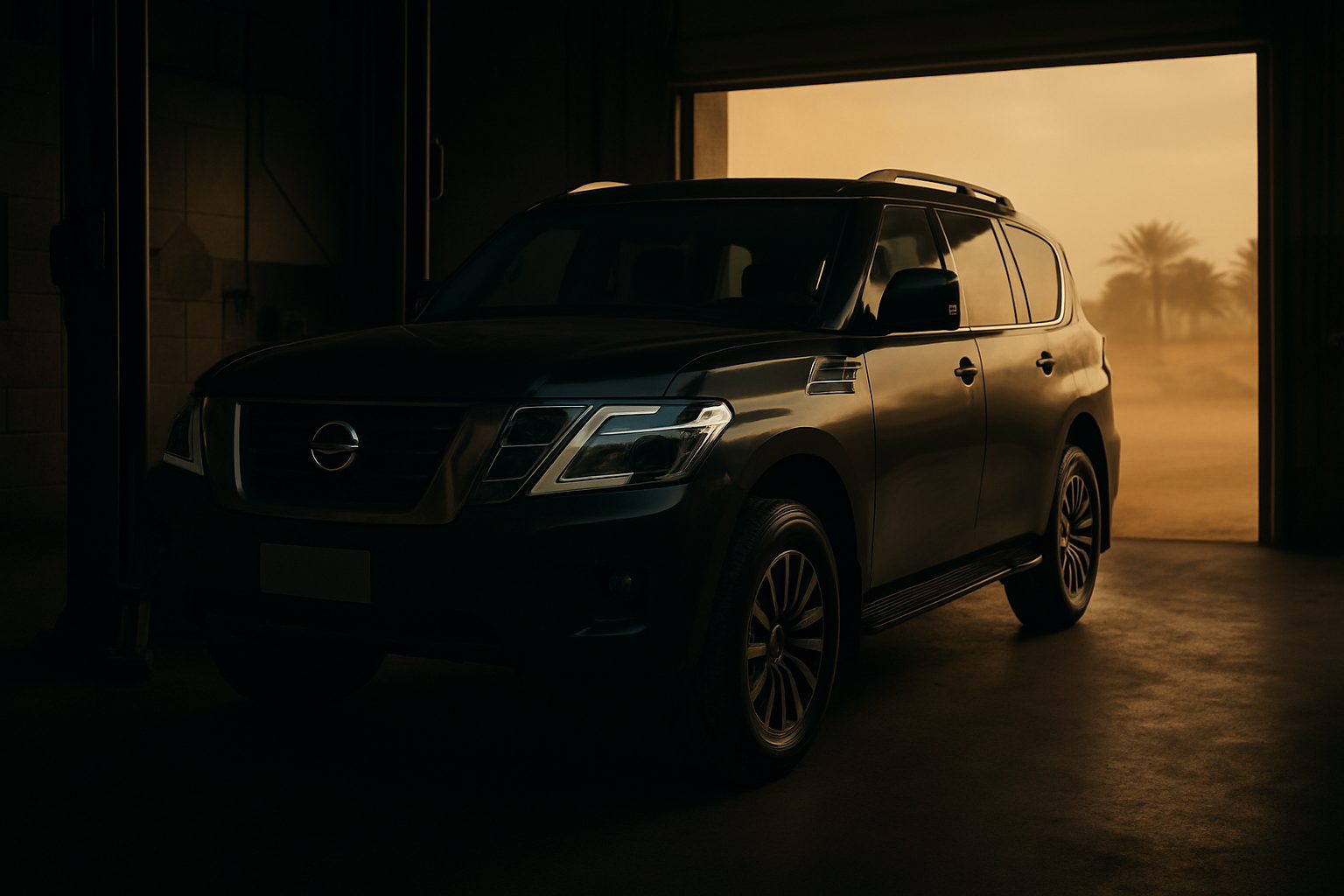
Part of: Nissan Patrol Y62 Gearbox and Transmission Problems in Dubai
A pause before Drive or Reverse takes hold in a Nissan Patrol Y62 usually points to one of three things: fluid that has broken down and lost its ability to build pressure quickly, a valve body that is slow to route that pressure, or a torque converter that is not carrying drive cleanly during engagement. Which one it is depends on when the delay happens, how long it lasts, and what the fluid looks like. A gearbox that hesitates for a second is not the same problem as one that clunks and then surges, and the difference matters before anything is opened.
Abu Dhabi puts a specific kind of strain on a Y62 gearbox. The combination of 45 to 50 degree ambient heat, stop-start traffic through Mussafah and along the Sheikh Zayed corridor, and the way many owners here use their car across all conditions, from daily commutes to desert runs, means the seven-speed JR710E automatic works harder than it does almost anywhere else. Fluid that is still within a reasonable distance interval can still be thermally worn out. And a gearbox that feels fine once it is warm may have been hiding a problem for months during those first cold moments every morning.
Delayed engagement is the symptom people describe in different ways. Some say the car hesitates. Some say there is a clunk followed by a jolt. Some say it just feels soft, like nothing is happening for a second or two. All of them are describing the same gap between the selector moving and the transmission actually pulling. That gap is information, and the details around it narrow the diagnosis before the car is even on a ramp.
What does delayed engagement actually feel like in a Y62?
The symptom is a pause, usually between one and three seconds, after the selector is moved from Park to Drive or from Drive to Reverse before the gearbox takes hold and the car pulls.
It is worth distinguishing between a few variations, because they point in different directions. A soft, progressive engagement where the car eases into gear slowly is usually a pressure problem. The hydraulic system is not building force fast enough to clamp the clutch packs cleanly. A clunk followed by a lurch is different. That is typically the opposite: pressure arriving too late and then engaging everything at once. Both feel like a delay from the driver's seat, but one is about fluid pressure being too low, and the other is about it arriving unevenly.
Also worth noting is whether the delay happens after the car has been sitting, or whether it also happens when the gearbox is already warm. A cold-only delay that disappears within a minute of driving tells a different story from a delay that is present regardless of temperature. If the car is slow to engage first thing in the morning but perfectly crisp once it has been running for a few minutes, that is a strong signal that fluid condition and cold-viscosity behaviour are involved. If the delay is there whether the car is cold or hot, the problem is likely further along.
Check the fluid before anything else
Fluid condition is the first thing to establish, because it either explains the symptom entirely or tells you to look further. This is the work we do as Y62 gearbox repair in Mussafah.
The JR710E takes Matic S ATF. What that fluid looks like and smells like after use tells you a great deal about what has been happening inside the gearbox. Fluid that is still clean and reddish is not ruling anything out, but it does make a fluid-only cause less likely. Fluid that is dark brown, opaque, or carries a burnt smell has been running hot. Heat cycles break down the friction modifiers in ATF, and when those are gone the clutch packs cannot engage smoothly. A burnt smell in particular is the fastest way to separate a fluid problem from a mechanical one before a single bolt is turned.
In Abu Dhabi's heat, fluid degrades faster than the odometer alone would suggest. A car that has covered most of its mileage in heavy traffic, or that has done regular off-road runs in summer, will have put more thermal stress on the fluid than the same distance on a cooler highway. The fluid check is cheap. Skipping it and going straight to a valve body or solenoid diagnosis wastes time if the fluid is the problem, and it means you are fitting new parts into a contaminated environment if it is not.
Cold delay versus warm delay: why the difference matters
When the delay only happens when the engine is cold, the fluid's cold-temperature behaviour is usually the starting point.
ATF thickens when cold. In a climate like Abu Dhabi, where the car may have sat overnight in a cooler garage, the fluid is denser when you first start up than it will be ten minutes later. If the fluid has also been run hot repeatedly and its additives are depleted, that density works against it even more. The pump has to work harder to move thicker fluid through the valve body, and the passages that route pressure to the clutch packs respond more slowly. The result is a brief but noticeable pause before Drive takes.
A delay that is equally present when the gearbox is at full operating temperature is a different matter. At that point the fluid is doing what it can, and if it still cannot deliver consistent engagement, the problem is more likely in the valve body, a solenoid, or the mechanical condition of the clutch packs themselves. The solenoids are small electro-hydraulic valves that control where fluid pressure goes and when. When one is slow or sticking, the pressure routing lags behind the selector input and you feel it as a delay.
This is also why the car is worth road-testing properly before anything is disassembled. A scan tool can pull fault codes, but a gearbox that hesitates only when cold may not throw a stored code at all. The symptom disappears by the time the car is warm enough to scan reliably, and the code memory is empty. The road test, done cold, is more informative.
What we check on the ramp, and in what order
The diagnostic sequence runs from the least invasive to the most, and the early steps often settle the question.
We start with fluid condition and level, because both matter. Low fluid level reduces the pump's ability to build and sustain pressure. Dark or burnt fluid tells us the clutch packs have been running in degraded lubrication. A scan across every relevant control module follows. The transmission control unit stores shift data, solenoid response times, and pressure adaptation values, and those values can show that the gearbox has been compensating for a pressure problem long before the driver noticed anything obvious.
We then compare command data against actual behaviour. The TCU tells a solenoid to open. The question is whether the gearbox responds at the right moment. When there is a gap between the command and the response, that gap usually sits in the solenoid itself, in the valve body bore around it, or in the fluid passages feeding it.
The pan inspection comes next if the fluid or scan data points toward internal wear. The oil pan on a JR710E accumulates debris, and the pattern of that debris is informative. A small amount of fine black material is normal over a long service life. Bright metallic particles, or chunks of friction material, mean something mechanical has been shedding. That changes the conversation from a fluid service or solenoid replacement to a more involved strip-down.
Only after all of that do we form a view on whether this is a fluid-and-solenoid job or a gearbox that needs to come apart.
The clunk on engagement: valve body or torque converter?
A sharp clunk when the car goes into gear is usually either a valve body issue or torque converter behaviour, and they feel similar from the driver's seat.
The valve body is the hydraulic brain of the gearbox. It routes fluid pressure to the right clutch pack at the right moment. When a valve in it is sticking or a bore has worn enough to allow pressure to bypass where it should be going, engagement becomes unpredictable. Sometimes pressure arrives late. Sometimes it arrives in a rush. The clunk is pressure arriving too abruptly after a brief absence.
The torque converter sits between the engine and the gearbox and transfers drive through fluid during low-speed engagement, before the lockup clutch takes over. When the converter's lockup clutch is worn or its damper springs are fatigued, the transition between fluid drive and mechanical drive becomes rough. This can produce a shudder rather than a clunk, but the two are sometimes close enough to confuse until the car is on the ramp and the data is in front of you.
The distinction matters because a valve body repair or solenoid kit is a very different job from torque converter work. Getting this wrong means fitting parts that do not fix the symptom.
When to stop driving the car
A hesitation that has been present for less than a week and disappears fully once the car is warm may be safe to drive to the workshop. It still needs diagnosing soon, not in a few months.
Stop driving it and call us first if the delay is more than two or three seconds, if there is a clunk followed by a noticeable jolt, if the delay is getting longer over days or weeks, or if the fluid smells burnt. A slipping clutch pack generates heat. Heat damages everything around it. A gearbox that is repairable today may not be repairable after another week of the same behaviour, because the debris from a failing clutch pack circulates through the valve body and scores surfaces that would otherwise be fine.
The drive from Abu Dhabi to Mussafah is not long. But a gearbox that is actively slipping is not degrading at a steady rate. Tell us what it is doing before you drive it.
Common questions from Y62 owners
Is a delayed engagement always a sign the gearbox needs to be rebuilt?
Not at all. Many delayed engagement faults on the Y62 are resolved with a fluid service, a solenoid replacement, or valve body work. A full rebuild becomes necessary when there is confirmed mechanical damage inside the gearbox, usually visible as heavy metal contamination in the pan or persistent clutch slip that has caused heat damage. The symptom alone does not tell you how far in the problem goes. That is what the diagnostic sequence is for.
Can I film the symptom to send before bringing the car in?
Yes, and it is genuinely useful. Film from inside the car at the moment of engagement, with the sound on. What we want to hear is whether there is a clunk, a soft fade-in, or a jolt. If the delay only happens when the car is cold, film it first thing in the morning before it has warmed up. Send the video along with the mileage and whether the gearbox fluid has ever been changed. That is usually enough to tell us whether this sounds like a fluid job or something that will need the car for longer.
Does the delay get worse if I keep driving on it?
It can, and the risk is not linear. A gearbox that is slow to engage because of degraded fluid or a lazy solenoid may stay at that level for a while. But if the root cause is a clutch pack that is starting to slip, the heat it generates accelerates the damage. Fluid that was marginal becomes contaminated. Valve body bores that were fine start picking up debris. The same job that would have been a solenoid kit six weeks ago can become a full rebuild by the time the owner decides to act.
Why does the delay only happen in the morning and then go away?
Cold ATF is denser than warm ATF, and if the fluid has been thermally cycled many times without being changed, its cold-weather behaviour is worse than it should be. The pump has to push thicker fluid through passages that are designed for fluid at operating temperature, and pressure builds slowly. Once the gearbox reaches normal temperature the fluid flows freely, engagement feels normal, and the symptom disappears. This makes it easy to dismiss as nothing. It is worth addressing before it becomes a warm-and-cold problem.
When to bring it to Top Challenger
We specialise in the Nissan Patrol Y62, with the Mussafah workshop in Abu Dhabi and a second workshop in Ras Al Khor, Dubai. Both do the same work on the Y62. Send us a message on WhatsApp with the mileage, what the car is doing, and whether the delay is cold-only or always present. If you have a short video of the symptom, include that too. We will tell you what it is likely to be and whether to drive it in or wait for us to advise further. We handle Y62 gearbox repair at the Mussafah workshop in Abu Dhabi.
Last updated: October 2026